


Friday, May 14, 2010


Monday, May 10, 2010
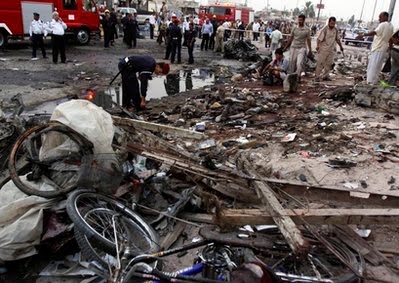
Attacks kill over 102 in Iraq, al Qaeda blamed




10 May 2010 19:29:57 GMT
Source: Reuters
* Textile factory workers attacked in Hilla
* Suicide bombers hit southern marketplace
* Bomb explodes in southern oil hub Basra
(Adds U.S. comment)
By Aseel Kami and Suadad al-Salhy
BAGHDAD, May 10 (Reuters) - Bombers and gunmen with suspected links to a battered but still lethal al Qaeda killed more than 100 people on Monday in a wave of attacks on markets, a textile factory, checkpoints and other sites across Iraq.
The attacks wounded more than 300 others in the capital, Baghdad, the southern oil hub of Basra and other towns and cities, and appeared aimed at showing Iraqis that Sunni Islamist insurgents were still a potent force, even after battlefield defeats in recent weeks. "Despite strong strikes that broke al Qaeda, there are some cells still working, attempting to prove their existence and their influence," said Baghdad's security spokesman, Major General Qassim al-Moussawi, calling the attacks "hysterical".
The attackers exploited the political disarray that followed a March 7 election that produced no outright winner and pitted a cross-sectarian bloc backed by minority Sunnis against two major Shi'ite-led coalitions.
Two months on, results have not been certified after an election that Iraqis hoped would deliver stable governance as U.S. troops prepare to withdraw more than seven years after ousting Sunni dictator Saddam Hussein.
In the bloodiest incident on Monday, two suicide car bombers drove into the entrance of a textile factory as workers were ending a shift in the town of Hilla, south of Baghdad, a regional office of the national media centre said.
A third bomb exploded as police and medics rushed to the scene, causing additional casualties. At least 45 people died and 190 were wounded, a hospital source said.
"This looks like a major campaign by the terrorists, not just in Hilla," said Babil province governor Salman al-Zarqani. The attacks were a reaction to efforts by Shi'ite factions to form a governing coalition after the March 7 election, he said.
The deadliest attack saw two suicide car bombs detonate simultaneously in the car park of a textiles factory in the central city of Hilla, followed minutes later by a third car bomb, police Captain Ali Al-Shimmari told AFP. About an hour later, according to Shimmari, a fourth explosives-packed vehicle exploded, engulfing the area as emergency workers treated victims at the scene. At least 50 people were killed and 140 wounded, said director of al-Hillah General Hospital.
The southern oil city of Basra was struck by three car bombs killing 21 people and wounding more than 70 others, security and medical sources said. The first was in a central market and the other two exploded in northern Basra near a petrol station and in a residential area.
Oil production, the bulk of which comes from fields outside the city, was not affected.
Earlier, a suicide bomber wearing an explosives-laden vest and another driving a car killed 13 people and wounded 40 in a marketplace in al-Suwayra, 50 km (30 miles) southeast of Baghdad, said Majid Askar, an official with the Wasit provincial council.
At dawn in Baghdad, gunmen equipped with silencers killed at least seven Iraqi soldiers and policemen when they attacked six checkpoints, while bombs planted at three others wounded several more, an Interior Ministry source said.
"This was a message to us that they can attack us in different parts of the city at the same time because they have cells everywhere," the source said.
A series of further attacks in the western province of Anbar, the volatile northern city of Mosul, the northern and western outskirts of Baghdad and elsewhere took the death toll from Monday's bloodshed to at least 102, with about 350 wounded.
SHOW OF STRENGTH
The attacks reaffirmed the continuing vigour of the insurgency after government forces dealt a series of blows to al Qaeda's network in recent weeks, including an April raid that killed Abu Ayyub al-Masri, the leader of al Qaeda in Iraq.
Overall violence in Iraq has subsided sharply since the height of sectarian warfare in 2006-07, but the March election has fuelled tensions again.
The cross-sectarian alliance led by former Prime Minister Iyad Allawi, a secular Shi'ite, rode strong support from Sunnis to take a two-seat lead in the parliamentary vote.
Iraq's main Shi'ite-led coalitions, however, have agreed to form an alliance that could deprive Allawi of a chance to try to form the next government, potentially angering Sunnis.
At a news conference on Monday before a meeting of Iraqiya's winning candidates, Allawi repeated his assertion that his bloc had the right to make the first attempt at forming a government.
"We will not allow ... our hands to be tied against attempts to undermine Iraqiya and confiscate the will of the Iraqi electors," he said.
A U.S. State Department spokesman said in Washington U.S. operations and personnel in Iraq had not been affected by Monday's attacks.
"These attacks will not undermine the confidence the Iraqi people have demonstrated in their government and their security forces," he said. "The Iraqi people overwhelmingly reject violence as a way to address their political differences." (Additional reporting by Ahmed Rasheed and Rania El Gamal in Baghdad and Habib al-Zubaidi in Hilla, Reuters Television; Writing by Michael Christie; Editing by Mark Trevelyan)
----
By REBECCA SANTANA and LARA JAKES, Associated Press Writer Rebecca Santana And Lara Jakes, Associated Press Writer – Mon May 10, 7:03 pm ET
BAGHDAD – A man with explosives strapped to his body blew himself up in a crowd, bombers struck a southern city and gunmen sprayed fire on security checkpoints in attacks Monday that killed at least 100 people — most of them in Shiite areas — in Iraq's deadliest day this year.
Officials were quick to blame insurgents linked to al-Qaida in Iraq for the shootings in the capital, saying the militants were redoubling efforts to destabilize the country at a time of political uncertainty over who will control the next government.
Shiite Vice President Adel Abdul-Mahdi stressed the importance of quickly forming a government that does not exclude any major political group to try to prevent insurgents from exploiting Iraq's fragile security.
"The terrorist gangs perpetrated new assaults today on our people and armed forces," he said. "We call on all political blocs to work seriously for the benefit of the country and ... start to form a national partnership government including all political parties without marginalizing any one."
More than two months after the March 7 election, Iraq's main political factions are still struggling to put together a ruling coalition. Prime Minister Nouri al-Maliki's Shiite bloc has tried to squeeze out election front-runner Ayad Allawi — a secular Shiite who was heavily backed by Sunnis — by forging an alliance last week with another religious Shiite coalition. The union, which is just four seats short of a majority in parliament, will likely lead to four more years of a government dominated by Shiites, much like the current one.
Sunni anger at Shiite domination of successive governments was a key reason behind the insurgency that sparked sectarian warfare in 2006 and 2007. If Allawi is perceived as not getting his fair share of power, that could in turn outrage the Sunnis who supported him and risk a resurgence of sectarian violence.
The relentless cascade of bombings and shootings — hitting at least 10 cities and towns as the day unfolded — also raised questions about whether Iraqi security forces can protect the country as the U.S. prepares to withdraw half of its remaining 92,000 troops in Iraq over the next four months.
The U.S. and Iraq have claimed major blows again al-Qaida in Iraq over the last month — most notably the killings of two militant leaders Abu Omar al-Baghdadi and Abu Ayyub al-Masri in an April 18 raid on their safehouse near Saddam Hussein's hometown of Tikrit.
But U.S. Maj. Gen. Stephen Lanza, the top military spokesman in Iraq, said Monday's attacks show "there is a threat out there that we have to be concerned about, and the threat is still capable."
The violence began before dawn in Baghdad in a series of attacks against checkpoints and patrols, targeting security forces. Gunmen disguised as cleaners used weapons fixed with silencers to spray security forces with bullets. At least 10 people were killed.
Most of the day's casualties were in two Shiite-dominated cities where wounded victims screamed their fury at the government for failing to protect them.
The worst violence hit the Shiite city of Hillah, the capital of Babil province 60 miles (95 kilometers) south of Baghdad. First, two parked car bombs near a textile factory exploded as workers were leaving the factory around midday, said Babil provincial police spokesman Maj. Muthana Khalid.
Then as rescuers and workers were trying to help the injured, a suicide attacker with explosives strapped to his body blew himself up in the crowd.
At least 45 people were killed and dozens more injured, according to Khalid and al-Hillah hospital director Zuhair al Khafaji.
"It was a horrible scene with human flesh and blood on the ground," said Jassim Znad Abid, a taxi driver who lives in Hillah. "I saw dead people, some burned and crying, wounded people on the ground that was covered with pools of blood."
Babil provincial Gov. Salman Nassir al-Zargani ordered flags lowered to half-staff and a three-day mourning period. In an interview with Iraqi state TV, he said he was informed Sunday that the factory was under threat, but cited too many security gaps across Babil to protect all sites he feared could be targeted.
"There are many fragile places especially in the north of Babil... and there are a lot of security gaps there," he said. "So we are facing a daily challenge in Babil."
Hillah has been the site of horrific bombings in the past, including blasts in 2007 that killed at least 120 people and a suicide car bomber in 2005 that killed 125 people, mostly police and national guard recruits.
In another Shiite city, the southern port of Basra, three bombs, including one that targeted a marketplace, killed at least 16 people, hospital and police officials said. Basra has been relatively quiet since the days when Shiite militias allied with Iran ruled the streets; al-Maliki, with heavy U.S. support, routed the militias in 2008.
A pair of bombs struck the small town of Suwayrah, 25 miles (40 kilometers) south of Baghdad, killing 11. Three different bombings in the town of Abu Ghraib west of Baghdad that killed at least six people.
Twelve more were killed in five separate attacks stretching from the northern city of Mosul to the western city of Fallujah in Anbar province to the Shiite city of Musayyib south of Baghdad.
The attack in Mosul killed at least two people near a checkpoint run by Iraqi security forces, Kurdish security forces known as the peshmerga, and U.S. troops. The joint checkpoints were set up earlier this year under U.S. supervision as a way to get Iraqi and Kurdish forces working together in areas claimed by both the Kurds and Iraq's federal government.
Daily violence in Iraq has eased since the height of the insurgency. But the latest attacks raise fears that the country's barely contained sectarian tensions could once again explode — especially at a time of clouded political leadership. However, there have been few, if any, examples if the retaliatory violence that marked the sectarian conflict just a few years ago and brought Iraq to the brink of civil war.
On Monday, Allawi told reporters he has been trying for days to meet with al-Maliki and begin hammering out a compromise, but to no avail. He vowed to fight attempts to overturn the election results and called for an end to efforts to disqualify some of his Iraqiya coalition's winning candidates.
"We won't stand still if the harm against Iraqiya continues," Allawi said.
__
Associated Press Writers Saad Abdul-Kadir and Qassim Abdul-Zahra contributed to this report.
Tuesday, May 04, 2010
Tehran beggars make 1,500 dollars a month
Updated at: 1425 PST, Tuesday, May 04, 2010 ShareThis story
TEHRAN: Beggars in the Iranian capital earn the equivalent of 1,500 dollars a month -- five times the official minimum wage – a local news agency reported on Tuesday.
"Tehran beggars make at least 500,000 rials (50 dollars) a day or 15 million rials a month," the agency quoted Sadegh Avvali, the official in charge of social services at Tehran municipality, as saying.
He said that most beggars roaming the streets asking for change in the sprawling capital come from villages and remote towns or are foreigners, and that authorities round up about 300 vagrants and beggars daily.
Under a municipality initiative, panhandlers and vagrants would be picked off the streets and sent to shelters at night, the news agency quoted him as saying.
Beggars, including women and children, routinely roam the Iranian capital and other large cities, especially the religious hubs such as the northeastern city of Mashhad.
Homeless children and adults also often sell flowers and chewing gum at busy intersections.
The Iranian minimum wage equals about 300 dollars a month, and many Iranians believe that giving alms is a charitable act that also prevents mishaps.
---
Minimum wage set at Rs7000 in Labour Policy 2010
Updated at: 1645 PST, Saturday, May 01, 2010 ShareThis story
ISLAMABAD: Prime Minister Syed Yousuf Raza Gilani on Saturday announced a minimum Rs 7000 salary for laborers and a policy that aims at transforming the lives of working class for a better future.
Addressing a large gathering here at the Convention Centre Prime Minister Gilani apprised the large gathering of workers from across the country about the features of the new labour policy that was given an approval at a special cabinet meeting convened earlier in the day.
He said the Cabinet approved the Labour Policy 2010 that was reflective of the vision of Shaheed Mohtarma Benazir Bhutto and was an attempt to implement it practically. He said the policy would benefit around 50 million labours who were playing a key role in the progress and development of the country.
Prime Minister Gilani said the credit goes to President Asif Ali Zardari for pursuing the labour friendly policies.
Gilani quoted a hadith of Holy Prophet (Peace be upon Him) to pay a labour his wages before sweat dries and said it was the endeavour of his government to follow it in letter and spirit.
Gilani informed the gathering about the measures and said trilateral monitoring committees would be set up at provincial and federal level to improve working, resolve problems and increase efficiency of the labours.
He assured that contract employees would be regularised in government departments. He also announced salaries will be made through banks, retired registered workers will get medical facilities, raise in pensions would be in accordance to increase in government pensions, technical education for children, manpower information centres in cities, training of trainers, para-medical staff to get specialised training, pensionable age limit under the old-age benefit lowered to 50, smart card through Nadra so that registered workers get all facilities, Rs 15,000 for out of job workers and legal support, free medical treatment for labours.
He said the workers have been given the right to have Unions and labour bodies to protect their rights. Gilani was appreciative of all the political parties and the provincial governments for their input and endorsing the new labour policy.
Monday, May 03, 2010
Shooting near Oakwood and Vaughan Rds.
Tue Apr. 13 2010 3:29:02 PM
Police find shell casings in shooting near school
Web Staff, cp24.com
Members of the Emergency Task Force respond to a shooting near Vaughan Road Academy. (CP24/Tristan Phillips)
Members of the Emergency Task Force respond to a shooting near Vaughan Road Academy. (CP24/Tristan Phillips)
Toronto police have found two shell casings following reports of gunfire near Vaughan Road Academy in midtown.
Const. Tony Vella says officers were called to the Vaughan Road and Oakwood Avenue area just after 1 p.m. for reports of gunfire.
Emergency Task Force officers found two shell casings on Atlas Street, one block east of the school.
However, Emergency Medical Services say they haven't found a patient and Vella says it's unclear if anyone was shot. Police are questioning three males at the scene.
Toronto District School Board spokesperson Kelly Baker says the school was placed in "hold and secure" mode for a short time.
----
Shooting near Oakwood and Vaughan Rds.
Published 43 minutes ago
Gloria Er-Chua Staff Reporter
A man in his 20s was shot in the chest in Toronto’s west end on Monday afternoon.
The shooting occurred near Vaughan Rd. and Winona Dr. just before 4 p.m.
The victim, who showed no vital signs, was transferred to a hospital downtown, an EMS official said.
Police are investigating on scene.
Saturday, May 01, 2010
Khwaja’s fate was sealed after spying charges
Saturday, May 01, 2010
By Rahimullah Yusufzai
PESHAWAR: When the militants accuse someone of spying, chances are that the person’s fate is sealed.
Former Inter-Services Intelligence (ISI) official Squadron Leader (retd) Khalid Khwaja’s fate also became uncertain when his kidnappers belonging to the previously unknown militant group, the Asian Tigers, released a video-tape in which he was coerced into admitting that he had been spying for the ISI and the American CIA. By recording his confession, obviously at gun-point, the group’s leaders had apparently made up their mind to eliminate Khwaja.
The militants, whether al-Qaeda or Taliban, show no mercy to people they consider as spies. They justify the harshest punishment to spies on religious grounds.
The militants associated with Asian Tigers, which obviously is a fake name, had kidnapped Khwaja along with another former ISI official Colonel (retd) Sultan Amir Tarar, commonly known as Colonel Imam, and British journalist Assad Qureshi, in North Waziristan on March 26. They took their time to release videos of the kidnapped men and then set deadlines for their demands to be met. On the expiry of the deadline, they executed Khwaja and are threatening to mete out the same fate to Colonel Imam and Asad Qureshi if the Pakistan government doesn’t accept their demands.
Often, the militants execute one person to pressure the government to accept their demands to save the other persons made hostage. The same strategy has been adopted in this case. However, the government is unlikely to release the Afghan Taliban commanders Mulla Abdul Ghani Baradar and Mansoor Dadullah on the demand of the Asian Tigers in exchange for Colonel Imam and Asad Qureshi. The third Afghan Taliban commander, Mulla Abdul Kabir, whose release was demanded by the militants, is apparently not in the custody of the Pakistani intelligence agencies.
One didn’t expect the militants to execute Khwaja, a vocal supporter of militant causes and a strong critic of the US. That they have taken this extreme step shows that they are ready for the consequences, which could eventually include a major military operation in North Waziristan. That is probably what this group of militants would want as they are mostly outsiders and include the Punjabi Taliban and Mehsud fighters of the TTP evicted from South Waziristan as a result of the Pakistan Army operations there. They would like North Waziristan to become embroiled in this battle and the Pakistan Army to be engaged in a wider battlefield.
Hafiz Gul Bahadur, the leader of the non-TTP Taliban in North Waziristan, has been trying to save his peace accord with the government but he appears helpless in checking the activities of militants who have come from outside and found sanctuaries in his area.
Subscribe to:
Posts (Atom)
