RT News

Sunday, November 16, 2008

Thousands of Iraqi Arabs attend anti-Kurdish protests

by Hassan al-Obeidi Hassan Al-obeidi – Sat Nov 15, 2:21 pm ET
Thousands of Iraqi Arabs attend anti-Kurdish protests AFP/File – Kurdish regional president Massud Barzani, seen here on November 12, 2008, has questioned new alliances …


TIKRIT, Iraq (AFP) – Thousands of Sunni and Shiite Arabs took to the streets across Iraq Saturday to defend Prime Minister Nuri al-Maliki against criticism from leaders of the country's Kurdish minority.

Demonstrations were held in the northern Sunni town of Tikrit -- the hometown of executed dictator Saddam Hussein -- the once-restive Sunni town of Hawijah, and the mostly Shiite southern cities of Karbala, Najaf, Nasiriyah, Samawah, and Hilla, AFP correspondents said.

They came out to protest remarks made earlier this week by Kurdish regional president Massud Barzani, who accused Maliki of illegally allying with tribes in areas with large Kurdish populations to expand the power of the state.

In his remarks Barzani had compared the tribal alliances -- which Maliki refers to as "Support Councils" -- to the so-called Jackass Brigades of Kurds who fought for Saddam against Kurdish rebels from the 1980s up until 2003.

The dispute has exposed yet another potentially explosive faultline in a country still scarred by sectarian tensions that until a few months ago had transformed large parts of Iraq into grisly battlefields.

In Tikrit hundreds of Sunni tribesmen demonstrated in support of the Shiite prime minister, waving signs saying, "We want a unified Iraq" and "Kirkuk and Mosul and Diyala are Iraqi," referring to the three most disputed areas.

"The Iraqi tribes are with the national positions of Maliki in preserving the unity of Iraq, establishing the rule of law, and rewriting the constitution," said Farhan al-Aud, an MP and Maliki advisor from the province.

"There are no disputed areas. This is one country," he added.

Maliki has credited the mostly tribal councils with helping his forces route insurgents and militias, while the Kurds have viewed them as a power grab that could endanger their aspirations for a greater autonomous region.

"Those who oppose the plan of Maliki, they want Iraq to remain weak and to continue the project of dividing it up," said Ahmed al-Dulaimi, a member of the Support Council in the Salaheddin province, of which Tikrit is the capital.

In the oil-rich Kirkuk province -- hotly disputed and fractured into Arab, Kurdish and Turkmen communities -- thousands of Arabs gathered at a football stadium outside Hawijah, once a hotbed of the country's Sunni insurgency.

"All of Hawijah calls out to Maliki, Glory of our country!" the crowd chanted, reprising a slogan once used at rallies for Saddam. "With our souls, with our blood, we sacrifice for you, Kirkuk!" they cried.

Sheikh Barhan Mazhar al-Asi, an Arab member of Kirkuk provincial council, said the demonstrators had gathered to assert that "Kirkuk is Iraqi."

Iraqi Kurds, many of whom see Kirkuk's oil wealth as vital to the future viability of their region, have called for it to be placed inside their autonomous zone, a plan deeply opposed by the province's Arab community.

"The Support Brigades are nothing more than a way of providing stability and security, to restore the balance among state institutions and guarantee the rights of all communities in Kirkuk," Asi said.

At a similar demonstration in the Shiite holy city of Karbala south of Baghdad hundreds of tribesmen demonstrated in front of the governorate.

Provincial governor Aqil al-Khazali rejected Kurdish accusations that the Support Councils are unconstitutional.

"Where is the violation when the government embraces the Iraqi tribes for the future of a new Iraq," he told the crowd.

"Do they want to talk about the list of (their) violations? Is allocating 17 percent of the budget (to them) constitutional? Are the Peshmerga constitutional?" he said referring to the powerful Kurdish militia.

Most of Iraq's roughly five million Kurds live in the three northernmost provinces, which are governed by Barzani and are largely autonomous. The Kurds have long wanted to expand the zone, however, to include other Kurdish areas.

-----------

ACKGROUNDERS: MALIKI MAKES A PLAY FOR THE SOUTHERN TRIBES


Backgrounder #37
November 6, 2008
Scott Weiner


In the Shia dominated south of Iraq, a conflict is developing over political dominance in the upcoming provincial elections. Iraqi Prime Minister Nouri Al-Maliki has begun a campaign of tribal outreach in an attempt to consolidate his power at the national level. As a result, the Shia constituency in southern Iraq has become the political battlefield for Iraq's three major Shia political entities. These political movements are Dawa, the party of Prime Minister Maliki, the Islamic Supreme Council of Iraq (ISCI), and the Sadr Movement.

This backgrounder documents Prime Minister Maliki's tribal outreach in the summer and fall of 2008, and considers the implications for the Iraqi Shia political landscape. Additionally, it presents ISCI's reaction to this outreach program, documenting statements and actions by party leaders and affiliates to counter Prime Minister Maliki's push for dominance.

Throughout Operation Saulat al‐Fursan, Maliki used various methods in his outreach. He visited
tribal leaders and promised their kinsmen jobs in exchange for the political allegiance of their tribe.3 He
also issued statements thanking the tribes for their efforts to curb “criminal gangs” in Basra.4 Finally,
Maliki spoke in support of existing tribal councils, comprised of groups of tribal sheikhs and notables,
and praised them for their service to the country.5
As an immediate benefit of this outreach, Maliki was able to recruit 10,000 new fighters from
these tribes. 6 Ultimately, the help of these Shia recruits – and emergency reinforcements from
Coalition and Iraqi Security Forces– proved instrumental in clearing Basra of insurgents.7
Maliki’s outreach, however, was not limited to Basra. In Dhi‐Qar province, several tribes pledged
support to Maliki on March 30, 2008, along with members of the Dulaim tribe in Wassit province.8 A
week later, sixty‐nine more Wassit clan chiefs issued a document in support of the government.9
It is difficult to pinpoint precisely when Maliki’s consolidation of power rather than the success
of Operation Saulat al‐Fursan became the primary goal of his outreach. Following the success of tribal
outreach during the operation, it appears Maliki realized that tribal councils that were allied with the
national government meant not only material support for military operations but political support as
well. Thus, Maliki took advantage of his existing tribal network for a new broader purpose.
While ISCI supported Maliki’s military offensive against the Sadrists, evidence suggests that they
quickly became concerned with Maliki’s political rise. Additionally, the idea of local councils who
answered to the central government in Baghdad likely raised concern among the ISCI‐affiliated
governors in the southern provinces.
In an April 7, 2008 interview with Dubai Al‐Sharqiyah television, the head of the Southern Iraq
Tribal Council, Sheikh Kazim Unayzan, responded to these accusations. He highlighting the council’s
positive role in Operation Saulat al‐Fursan, and reiterated the non‐partisan nature of the council.10
However, Maliki’s outreach – and accusations of partisan maneuvering continued.

However, a June 28, 2008 meeting between Maliki and a member of the Ibadah tribe reveals a
significant shift in message. While he began his remarks by praising Iraqi solidarity, Maliki later
announced, “Neither this government nor future governments will interfere in the affairs of the tribe.
You have taken the step of meeting and deciding things as a tribe. This is the right option and
method.”17 This message is mirrored in statements Maliki made the following day to the Al‐Jabour tribe
and to the Al‐Maqasis Al‐Musawiyah tribe on August 1, 2008.18 Contrary to his March 2008 meetings,
Maliki offered the tribes limited autonomy in return for deference to Maliki’s national government. The
focus was no longer primarily on crime and reducing violence, but on this power‐sharing bargain struck
between Maliki and the tribes.19

On September 17, 2008, ISCI leader Taqi al‐Din al‐Moula accused the Dawa party of creating the
tribal support councils with a partisan agenda. He argued that the councils could eventually turn into
militias, which would be harmful to security.22 In addition to this pressure from ISCI party leadership in
Baghdad, members of the provincial councils in southern and central Iraq, many of whom were ISCIaffiliated,
also played a role. Days later, on September 22, 2008, the ISCI‐dominated Wassit Provincial
council categorically refused to establish a tribal council in the province.23 On September 28, 2008, the
governor of Dhi‐Qar, also affiliated with ISCI, followed suit and called the establishment of tribal support
councils a “violation of laws.”24

Already, Basra's tribal sheikhs have been targeted by gunmen or militiamen of unknown
affiliation. On July 16 Sayyid Aqeel Fahdi Jamal al‐Din, a prominent leader in the Al‐Ikhbaria Shia sect,
was the target of an assassination attempt.29 On September 19, the brother of Sheikh Mohammed al‐
Agrash, the leader of the Al‐Agrash and Al‐Daghaghila tribes was assassinated in Basra.30 On October 22,
gunmen tried, unsuccessfully, to kidnap Sheikh Abdul Wahab al‐Rubaei, head of the Southern Iraq Tribal
Institute for the Study of War, Maliki Makes a Play for the Southern Tribes, November 2008 7
Council.31 These examples indicate the lengths to which various groups are willing to go to advance their
agendas in the Iraqi south.

-----------

Many of the demonstrators who came out in support of Iraqi Prime Minister Nuri al-Maliki in the southern Iraqi city of Karbala on Wednesday traveled to the march from the PM's boyhood home in neighboring Babil Province, eyewitnesses report.


------

Iraq's presidency demands suspension of pro-Maliki groups

BAGHDAD (AFP) – Iraq's presidential council demanded on Friday that Prime Minister Nuri al-Maliki suspend pro-government tribal councils so their legality could be reviewed amid an escalating quarrel over them.

"We demand that you intervene to order a halt to the work of these councils until there is agreement about them, in order to provide administrative and legal cover for them," the council said in a letter posted on its website.

The so-called Support Councils have already drawn fire from Iraq's two main Kurdish parties, who earlier this month accused Maliki of creating his own militias to consolidate Baghdad's grip on ethnically mixed regions.

But the council statement -- coming from Iraqi President Jalal Talabani, a Kurd, Shiite Vice President Adel Abdel Mahdi and Sunni Vice President Tareq al-Hashemi, could set the stage for a wider political brawl over the groups.

The council has a veto power over all laws ratified by parliament.

Maliki has defended the Support Councils as a natural outgrowth of the Sahwa (Awakening) movement that began in the western province of Anbar in 2006, when the government allied with local Sunni militias to drive out Al-Qaeda.

The Sahwas have since expanded across the country and have played a key role in the dramatic improvement in security over the past year.

But the presidential council said the Support Councils formed more recently might be unnecessary and required legal review.

"For us to begin today to form councils paid for by the national budget to assume a role that has no known institutional or legal place, this is a situation that needs a serious pause," it said.

The statement said officials outside of the prime minister's office had received no briefings about the councils and were relying solely on press reports and public statements.

Both the Kurds and Shiite rivals to Maliki have objected to the councils, viewing them as an instrument of expanding the premier's power, fears that could deepen ahead of provincial elections slated for January.


----------

KRG Response to Accusations by Al -Maliki


BAGHDAD - At a press conference in Baghdad on November 20, Prime Minister Nouri al-Maliki made statements which angered the leadership of the Kurdistan Regional Government(KRG).

Among the comments made were, “I am surprised with the Presidential Board’s silence regarding the constitutional violations committed by the Kurdish leaderships, through opening offices for diplomatic missions, deploying forces to encounter federal governmental forces, in addition to using governmental funds to support tribes serving their parties’ interests.” He also said, “All oil contracts signed by Kurdistan’s government with foreign companies violate the constitution.”

Last week, during the security agreement wranglings in parliament, lawmaker Ala Talabani, in the Kurdistan Coalition bloc, told Iraqslogger, “These comments have changed the way we look at the prime minister’s power. We have some demands for him to respect minorities and territories in Iraq, and to respect the constitution, but we will support the security agreement because it is a different issue. Later, we must address the prime minister’s accusations.”


Today, a response was made in the form of a lengthy statement on the KRG’s website, with a focus on the Constitution, al-Maliki’s controversial "support councils", and, of course, oil. Below is the full text.


The development of good governance that effectively serves all the people all the time, in all corners of Iraq, is a long and extremely difficult work in progress. This work began with the overthrow of the former regime in 2003. It went through three interim governments culminating in the overwhelming approval of the Constitution in 2005 and the formation of a permanent government in 2006. From this initial formation of structure and system, the process has been progressing toward establishing partnerships and procedures, albeit sometimes with severe difficulty.


With due understanding and full respect for the traumatic history we have been passing through, which must neither be forgotten nor repeated, and the excessive burden of our troubled legacies, it is not surprising that the process of developing good governance is indeed so difficult.


It is thus unfortunate and deeply regrettable that the press conference of Iraq’s Prime Minister illustrates efforts being made to take the people of Iraq back to a period we are desperately trying to get beyond. It was a period where the excessive concentration, or centralization, of economic and political power condemned all Iraqi peoples to unimaginable suffering.


Prime Minister Nouri Al-Maliki’s press conference focused on a letter from the Iraqi Presidency Council questioning the formation of “Support Councils.” In reaction to this letter, the Prime Minister singled out the Kurdistan Region and described certain of its policies and actions to be unconstitutional.


Given the seriousness of these allegations, it is important that all Iraqis are better informed and become educated regarding the issues and facts.


“Support Councils”


These are tribal councils directly affiliated with the Office of the Prime Minister of the federal government. The Office has been contacting people in the Kurdistan Region, and in the so-called disputed areas. The people being contacted include former collaborators who were closely linked to the security and intelligence agencies of the defunct regime of Saddam Hussein.


The purpose is to enlist these people into forming groups that support the Prime Minister in the disputed areas. The groups are to be armed and they are to become part of the government structure, organized, equipped, and paid for by the federal government.


The former collaborators, who include tribal leaders of the Kurdistan Region, in the past, conspired against fellow citizens. They took active part in military operations that detained, tortured, and killed fellow citizens, including civilian women and children, for political reasons. They aided and abetted the forcing of thousands of families to migrate from their homes, and in destroying their communities.


Following the 1991 war and uprising, however, the Kurdistan Front, a consortium of opposition political groups, issued a general amnesty to all collaborators on the condition that they never again participate in such treachery and violations of human rights.


The Office of the Prime Minister has also contacted collaborators who actively participated in the Anfal, a campaign that the international community has determined to be genocide. These persons, who have been on the run since 1991, were not included in the general amnesty.


The amnesty successfully called for surrendering of arms and serving the part of Iraq that was liberated during the period 1991 to 2003. It began a new chapter, a process of reconciliation that led to a still deepening sense of forgiveness and tolerance. This was, indeed, an important strategy to engender and promote levels of personal security and political stability that the people of the Kurdistan Region enjoy today.


A result of this policy is that the Kurdistan Region became a safe haven for many former non-Kurdish Iraqi opposition leaders and their families. The Region became the stage for opposition groups to organize their activities against the former regime. Most of these groups are now part of the political process within the government of a new Iraq.


Enlisting such pro-regime collaborators into “Support Councils” in the Kurdistan Region and in the “disputed areas” could very well have the following effects:


1. Instability and discord within the Kurdistan Region on the order of what occurred during the rule of the former regime.


2. The creation of divisions in national reconciliation within the Kurdistan Region.


3. The creation of security lapses that allow infiltration of terrorists into the Region.


4. The creation of armed groups in the “disputed areas” that cause destabilization, divisions, and strife.


Establishing these “Support Councils” was not a consensus decision of the Iraqi Council of Ministers. Whether the councils are constitutional is a matter to be determined by the Iraqi Council of Representatives, the Iraqi Presidency Council, or the Federal Supreme Court.


The duty of the government is to create an environment conducive to reconciliation, not to reverse the progress already made. The government has the responsibility to provide security, not to create insecurity. The mission of the government is to create tolerance, not to plant the seeds of division.


These “Support Councils” cannot, and will not, contribute to national reconciliation. Nor can they contribute to peace and stability. These councils would have only a destabilizing effect because they are a re-creation of Saddam-era collaborator groups who brought death and destruction to the Kurdistan Region.


It would appear that the intention of these councils is to undermine the Kurdistan Region and to thwart reconstruction and development in an important part of Iraq. This counters the federal government’s responsibility to ensure security and to promote the political process. It counters efforts of the Kurdistan Region to promote national reconciliation and to shield it against forces that aim to destroy it.


Let us be clear. The days of generating divisions and sowing discord by government among the people of Kurdistan are over. Such attempts stem only from forces opposed to democratizing the political process. These efforts work against the unity and coalition federal government.


It is not surprising that such attempts have met with public denunciations before official responses have been made. These efforts pose a real danger and could lead to sedition, under the pretext of national reconciliation.


Constitutional Issues


Though the Prime Minister has taken the oath to promote and protect the Constitution of Iraq - as it currently exists - it is, indeed, disconcerting when he cites the Constitution in attacking others while apparently violating it when taking unilateral decisions. The Prime Minister is obligated to act within the limits of the current constitution and not in accordance with a future constitution he may prefer.


The new order in Iraq is based on the Constitution that was approved in a countrywide referendum. In his press conference, the Prime Minister regrettably offered opinion that the leadership and people of the Kurdistan Region are demanding more than what the Constitution allows.


In response, let us re-examine the Constitution, specifically the distribution of powers. According to Article-110, the exclusive powers of the federal government include formulating foreign policy; national security; formulating fiscal policy; regulating standards, weights, and measures; regulating immigration, residency, and citizenship; regulating the policies of broadcast frequencies and mail; drawing up the general and investment budget bill; and planning policies relating to water sources.


As for the powers of the regions, Article-121 states, “The regional powers shall have the right to exercise executive, legislative, and judicial powers in accordance with this Constitution, except for those authorities stipulated to be the exclusive authorities of the federal government.”


The Constitution, thus, clearly specifies the distribution of powers. The Kurdistan Region seeks no more power than the Constitution allows. It only seeks that the Constitution be implemented.


Oil and Gas Contracts


The Prime Minister has described the oil contracts signed by the Kurdistan Regional Government to be in violation of the Constitution.
On existing oil and gas fields, Article-112 of the Constitution affirms:


“First: The federal government, with the producing governorates and regional governments, shall undertake the management of oil and gas extracted from present fields provided that it distributes its revenues in a fair manner in proportion to the population distribution in all parts of the country, specifying an allotment for a specified period for the damaged regions which were unjustly deprived of them by the former regime, and the regions that were damaged afterwards in a way that ensures balanced development in different areas of the country, and this shall be regulated by law.


“Second: The federal government, with the producing regional and governorate governments, shall together formulate the necessary strategic policies to develop the oil and gas wealth in a way that achieves the highest benefit to the Iraqi people using the most advanced techniques of market principles, and encouraging investment.”


As for future oilfields and future exploration, Article-115 is very clear that “all powers not stipulated in the exclusive powers of the federal government belong to the authorities of the regions and governorates that are not organized in a region. With regard to other powers shared between the federal government and the regional government, priority shall be given to the law of the regions and governorates not organized in a region in case of dispute.”


Article-141 of the Constitution also states that legislation enacted in the Kurdistan Region since 1992 shall remain in force, and decisions issued by the Kurdistan Regional Government, including court decisions and contracts, shall be considered valid unless they are amended or annulled pursuant to the laws of the Kurdistan Region by the competent entity in the Region, provided that they do not contradict the Constitution.


The issue centers on the status of oil contracts. Some of the oil contracts were signed even before the Constitution was written. Article-141 clearly establishes the legality of these contracts. As for the newly-signed contracts, which concern new oilfields, they all fall under the terms of Article-115 and Article-111 of the Constitution.
This calls for some explanation. On 15 February 2007, there was agreement on a draft hydrocarbon law. There was also a letter to the Iraqi Council of Ministers, dated 26 February 2007, signed by both the Iraqi President and Kurdistan Region President that was approved as an annex to the draft law. This letter urged the approval of the draft oil and gas law by the Iraqi Council of Representatives (COR, the national parliament), and the establishment of appropriate structures and mechanisms specified in the draft law.


The letter also said that if the draft law is not passed by the COR by the end of May 2007, then both sides would have the right to sign oil development and production contracts as per the Constitution. Thus, agreement on the draft law and the annex letter was clear. The annex letter also contains several conditions and commitments that have still not been met by the federal government. The question is why.


If we look at the Kurdistan Region’s oil contracts from an economic and oil-industry point of view, it is clear that:


1. These are oilfield development and oil exploration contracts that would promote capacity-building in the oil industry in the Kurdistan Region of Iraq.


2. Increasing oil production in the Kurdistan Region increases production for all Iraq.


3. Oil sale revenues, whether from the Kurdistan Region or from Basra in southern Iraq, accrue as national income for all Iraq.


4. The oil industry's infrastructure has not made any progress in other parts of Iraq as a result of the disastrous policies of the federal government, despite having spent around 8 billion dollars on this industry. In fact there has been a reduction in oil production and oil export. If this is the state of oil policy in Baghdad, should we be part of the failure or should we continue with our own oil policy in the Kurdistan Region to develop local capacity and attract expertise in the industry, so that we can contribute to a sound oil policy for the whole Iraq? What we have done is first and foremost in the interest of the whole country and then that of the Kurdistan Region.
Thus, increasing oil production and capacity-building in the Kurdistan Region is good for the country. Our actions have been constitutional and our contracts are good for all the people of Iraq.


Further, Kurdistan Region President Masoud Barzani has repeatedly said that if there have been any actions by the Kurdistan Region, including the signing of oil contracts, that are in any way in violation of the Constitution, we are prepared to review our position, acknowledge our errors, and abandon our actions. We believe the Constitution has the last word; all our actions derive their legitimacy from the Constitution.


It is also worth pointing out that in his policy announcement in June 2006, the Prime Minister confirmed his commitment to draft a new hydrocarbon law when he said “we will draft new legislation to regulate the hydrocarbon sector (oil and gas) which will also include the rights of regions and governorates as per the Constitution.”


US Military Bases in the Kurdistan Region


We would like to clarify the matter of inviting the US Military to establish bases in the Kurdistan Region, which the Prime Minister described as unconstitutional. This issue was raised when the Kurdistan Region President Masoud Barzani was asked a question recently in Washington DC. The question centered on “if” the Region would be prepared to host US Military bases. The President responded in the affirmative.


There is nothing new here. On behalf of the people of the Kurdistan Region, President Barzani, before most other Iraqi leaders, has repeatedly called for the signing of the status-of-forces agreement between Iraq and the United States. He has supported this policy for the good of all Iraq.


It is well known that there are currently no US military bases in the Kurdistan Region. “If” an agreement is signed, and “if” there is a request to have a US Military base in the Kurdistan Region, then there would be no objection.


Travel to the Kurdistan Region


The Federal Prime Minister pointed to restrictions on Iraqis travelling to the Kurdistan Region from other parts of Iraq, including the requirement that travelers must obtain an affidavit or proclamation from a local resident before they can travel to the Region. This may sound as if Iraqi citizens are prevented from travelling to the Kurdistan Region.


First, it is important to consider figures on Iraqi citizens who have become residents of the Kurdistan Region after fleeing threats of violence in other parts of the country. Our figures indicate that 10,559 Arab, Kurd, Turkmen, and Christian families have fled to, and now reside in, Erbil province. In Duhok province, the figure is 17,980 families. And in Sulaimniya province, it is 6,312 families.


In addition, some 1,900 university lecturers from outside the Kurdistan Region have joined universities in the Region. At least 3,740 students from Baghdad and Mosul and other places study in the Region’s universities. About 14,543 people from other parts of Iraq work as laborers in Erbil province while in Duhok the figure is 9,500.


As for restrictions on travel to the Region, it should be pointed out that there are more checkpoints in Baghdad than the total of all other checkpoints in the country. The Kurdistan Region has also been a target for terrorists. Some of our most prominent political leaders and many others have been victims.


As elsewhere in Iraq, checkpoints screen all travelers entering the Kurdistan Region regardless of their ethnic and religious background, whether they are Kurd, Arab, Turkmen, others, or foreigners. The procedures are not unlike those followed elsewhere in the country.


All peace loving people are welcome. This past summer, hotels in Duhok, Shaqlawa, Suleimaniyah, and other places in the Kurdistan Region, were full of guests from Baghdad, Mosul, and other parts of the country.


The Kurdistan Region accepts full responsibility for the security of all visitors and citizens alike regardless of their origin or background. The laws of the Kurdistan Region and the Iraqi Constitution allow us, and, in fact, they obligate us, to provide security in the Region. The measures we take are purely for security reasons to protect lives.
It should not be forgotten that in the past the Kurdistan Region was a sanctuary for people fleeing the oppression of the former regime. The mountains of our Region embraced them, including many of Iraq’s current leaders and their families. Many Christian families, Sabeans, and others who have fled the threat of violence have relocated to our Region. The doors of the Kurdistan Region shall remain open to all, except to terrorists.


Confrontation between Kurdistan Region forces and federal forces
The Prime Minister has referred to Kurdistan Region security forces as rebels even though they have consistently served the political process in the country. Indeed, in the early days, they were the only regular Iraqi force following the collapse of the former regime. Since then, they have played a key role in defeating terrorists and outlaws.


Kurdish military units are part of the Iraqi Army. If the Prime Minister was referring to the Kurdistan Regional Guards, the Peshmerga, these forces are authorized per Constitution Article-121 which states, “The regional government shall be responsible for all administrative requirements of the region, particularly the establishment and organization of the internal security forces for the region such as police, security forces, and guards of the region.”


The unfortunate and regrettable confrontation in Khanaqin was due to the unfortunate manner in which decisions were taken and regrettable miscommunication of orders. In effect, however, this incident emanated from excessive delay in implementing Constitution Article-140 for which the federal government is responsible.


Constitution Article-117 clearly recognizes the Kurdistan Region as a federal region but does not define its final boundaries. Constitution Article-143 accepts that the Kurdistan Regional Government (KRG) is the official government of certain specified territory. And, Article-140 calls for the disposition of other territories to be determined in accordance with a specified democratic process.


The boundary per Article-143 was unilaterally, and undemocratically, determined in October 1991. This boundary was militarized and within one month, in November 1991, more than 20,000 families were forced to migrate from areas south of the line - mostly from Kirkuk areas - to the territory north of the line.


Constitution Article-140 lays down a clear road map to define the final boundaries of the territory to be governed by the KRG. The excessive delay in implementing this article is the primary cause of tension and administrative problems in the so-called disputed areas. These are areas that suffered severely from ethnic cleansing and community destruction under the former regime.


Failure to implement Article-140 is also in violation of the policy of the Iraqi government which the Prime Minister announced in June 2006. The Prime Minister stated that “the government will be committed to implement Article-140 of the Constitution which is based on Article-58 of the ‘Law of Administration for the State of Iraq’. The Article specifies three phases for the implementation of this Article which include normalization, census, and a referendum in Kirkuk and other disputed areas. The government will start by taking the appropriate steps for the normalization phase, including by rejoining of the detached districts and sub-districts back to Kirkuk governorate, and complete this phase no later than 29 March 2007. The census phase will be completed by 31 July 2007 and the referendum phase by 15 November 2007. The question is why the Prime Minister has not met his commitments.


Attempts to send in the Iraqi Army and the creation of so-called “Support Councils” in these disputed areas are clearly intended to impede and abort the implementation of Article-140. The incident at Khanaqin was never about the deployment of the Iraqi army for security purposes. The area was already secure. It was, indeed, an attempt to change the facts on the ground, an attempt to bypass the Constitution.


The Iraqi Army did not face confrontation. What was confronted were orders and instructions taken unilaterally with flagrant political motives. The army was ordered to enter a peaceful and secure town that falls within the disputed areas of Article-140. There was no specific military objective. This kind of behavior poses a danger to the Iraqi Army and to the country.


The use of the national army to settle internal disagreements and political disputes is a violation of the Constitution. Constitution Article-9 states, “The Iraqi armed forces and security services will be composed of the components of the Iraqi people with due consideration given to their balance and representation without discrimination or exclusion. They shall be subject to the control of the civilian authority, shall defend Iraq, shall not be used as an instrument to oppress the Iraqi people, shall not interfere in political affairs, and shall have no role in the transfer of authority.”


Kurdistan Region representation offices abroad


In his remarks, the Prime Minister also talks about the opening of diplomatic offices abroad by the Kurdistan Region and describes them as a violation of the constitution. Once again, let the Constitution be the guide. Article-121 says, “Offices for the regions and governorates shall be established in embassies and diplomatic missions in order to follow cultural, social, and developmental affairs.”


Thus, the Constitution allows the establishing of diplomatic offices abroad. The expression “Offices for the regions and governorates shall be established” in this article implies that the initiative would be either from the Region or the federal government. Most probably this implies that the offices shall be established jointly by the two parties.


We cannot claim that the federal government has not taken any steps to initiate this process, and we are also not claiming that we do not share any of the blame for this. But foreign policy is the exclusive responsibility of the federal government and the federal government should have taken the initiative.


This issue requires examination of past practices and current requirements.


Part of the Kurdistan Region was liberated territory since 1991 and operated autonomously in accordance with UN Security Council Resolution 688 until the overthrow of the former regime in 2003. The Iraqi government unilaterally withdrew all administrative structures from the Region in October 1991. Legal and administrative institutions such as the regional parliament and the regional government were established following internationally-observed free and fair regional elections in May 1992.


The former Iraqi opposition parties, including the Prime Minister’s own party, dealt with the Kurdistan Region as a liberated part of Iraq. In late 1992, the Region hosted the largest gathering of Iraqi opposition parties. It was at this conference that the principle of federalism was formally proposed and adopted for Iraq.


During that time, there obviously was no diplomatic representation for the Kurdistan Region or other Iraqi opposition parties in Iraq’s embassies abroad. The opposition parties, including those of the Region, opened offices in a number of countries and the representatives of the Kurdistan Region abroad were among the most active.


Because of the large number of Iraqi Kurdish communities abroad, the Kurdistan Region’s representatives played an important role in helping to shape public opinion against the regime of Saddam Hussein. They were always available to help all Iraqi opposition parties, including the party of the Prime Minister.


The realities of Iraq, the existence of large Kurdish communities outside the country, and the need to shape public opinion abroad, all were factors that obliged us to have representation abroad. And now, we are ready to discuss and find a new arrangement for these offices, as soon as possible. We are also ready to take the initiative and propose our views, especially after the recent adoption of the foreign service law by the Iraqi parliament.


Abiding by the Constitution


The Kurdistan Region Presidency and the Kurdistan Regional Government are fully ready to enter negotiations to resolve all outstanding issues based on the Constitution. All sides, including the party of the Prime Minister, feel that the whole process is not moving in the right direction and that something needs to be done.


By acknowledging this situation, five committees have been established to determine a way forward on the contentious issues of consensus government; concept of partnership and the decisionmaking process; matters pertaining to security and the army; the problem of disputed areas; foreign policy; and the problems concerning the hydrocarbon law and budget. These five committees are composed of representatives from each of two Kurdistan parties, the Islamic Supreme Council of Iraq, the Iraqi Islamic Party, and the Islamic Dawa Party. We will abide by the recommendations of these committees.


A great deal is at stake. The Prime Minister calls on everyone to abide by the Constitution. In 2006, he described the Constitution as “among the best constitutions in the world because it is based on freedom, democracy, respect for human rights, and the rule of law.” In a speech on 8 November 2008, however, he said, “The Constitution was written in a hasty way and under extraordinary conditions. It limits the powers of the central government and it is feared that federalism will handicap the country.”


In other words, the Prime Minister considers the Constitution of Iraq to be the problem, a constitution which he took the oath to protect and implement. In fact, failure to abide by the Constitution is the problem.


The Prime Minister believes that centralization is the key to the problems of Iraq. Iraq’s history, however, has proven that centralization is dangerous. It has resulted in the country being controlled by a select group, and eventually by a single party and single individual.


The party of the Prime Minister was a victim of centralization. The people of southern Iraq were marginalized. The people of Kurdistan Region were considered second-class citizens. And the elite members of the Dulaimi tribe and western Iraq were brutally oppressed like others.


Not abiding by the Constitution portends the ominous:


1. The Prime Minister aims to suspend the Constitution. Despite his talk about the need to make amendments to the Constitution, what he really wants is to suspend the Constitution; a constitution which he participated in drafting and for which he has expressed admiration. The idea of suspending the constitution is a very dangerous action indeed. Amendments can be made to the Constitution and there is a mechanism set out in the Constitution for this purpose. Suspension of the Constitution is unacceptable to all parties, even those who opposed the constitution.


2. Imposing decisions of one party at the exclusion of participation in the decision-making process by other parties who are part of a coalition government. The Prime Minister applies the decisions taken by the Islamic Dawa Party (the Prime Minister’s faction) to the government. This is in violation of the Constitution and in violation of all the agreements we have. Most importantly, it is a violation of the program of the coalition government of federal Iraq.


3. Militarization of society by using the Iraqi Army for political purposes and establishing political groups armed and funded by the government. The Federal Prime Minister attempts to militarize the society and create Support Councils. In fact, these are all linked to and belong to his party. Of course, his party has the right to establish such organizations in accordance with regulations set out in the law. But they cannot be established in the name of the government and be funded and armed by the government.


4. The federal government does not rely on a law to govern the work of the Council of Ministers. The Council of Ministers doesn’t even have an agreed upon charter, so proposals and decisions are all drafted in the Office of the Prime Minister (by leaders of the Islamic Dawa Party) first and then presented to the Council of Ministers.


5. The Federal Prime Minister keeps maintaining that he is the only one in charge of the executive branch. But this is not the case when we look at Article-66 of the Constitution which says, “The federal executive power shall consist of the President of the Republic and the Council of Ministers and shall exercise its powers in accordance with the Constitution and the law.”


The Constitution has entrusted executive powers to the Council of Ministers. Prime Minister Nouri Al-Maliki is the head of the Council of Ministers. Important decisions must be made by the Council of Ministers headed by him. They cannot be taken by himself on behalf of the Council of Ministers. In the new Iraq, decisionmaking is not to be monopolized.


The Constitution requires the government to draft laws - to prepare bills and present them to the parliament for approval. Instead of doing this, the federal government continues to rely on old laws that gave the Revolutionary Command Council (established after the military coup in 1968 and acted as the ultimate decisionmaking body in Iraq before 2003) extraordinary legislative and executive powers, which is against the Constitution.


Relying on such laws that gave powers to the Revolutionary Command Council and the President is a return to an oppressive past that bypasses the Council of Ministers and the Council of Representatives (the national parliament).


The Kurdistan Regional Government is committed to the Constitution of Iraq. We are also committed to, and believe in, the principle of consensus. We respect all agreements that are in the interests of all the people of Iraq. We want democracy for all Iraq.


Iraq will remain strong when all its components are united. Iraq will progress through the strengthening of its federal foundations. It will remain a democratic country through distribution of political powers and revenues. We will continue on our march forward in providing security and peace for our people.


All this requires faith in the principle of consensus, partnership in government, and joint decisionmaking.


We reiterate that our guide to the future is the Constitution of Iraq on which we shall always rely. While the time for political niceties may well be over, we cannot – indeed, we shall not - accept anything that is contrary to the Constitution.



------

Clash in Iraq Over a Plan for Councils Intensifies


Article Tools Sponsored By
By ALISSA J. RUBIN
Published: December 3, 2008

BAGHDAD — A power struggle between Iraq’s prime minister and the Kurdish regional government intensified on Wednesday, when Prime Minister Nuri Kamal al-Maliki rejected Kurdish arguments that he could not create new tribal councils that would answer to his government.

The disagreement cuts to the heart of a broader dispute taking place in northern Iraq, particularly around Mosul and Kirkuk. Kurds are trying to expand their autonomous political control in the region, and many Iraqi Arabs are resisting, saying they want to remain under central government authority.

One potential shot in that battle has been a plan that Mr. Maliki began instituting last winter to create tribal councils that could help ethnic and sectarian reconciliation efforts in the provinces and keep a watchful eye for the entrance of insurgents. His government says the councils are unarmed volunteer groups, though that is a gray area, as every adult male is permitted one gun.

But Kurdish officials fear that the councils will instead be full-fledged militias that could be used against them in the north. The Kurdish government sent a letter on Monday that harshly criticized the plan and claimed that Mr. Maliki was recruiting former supporters of Saddam Hussein to join the councils and keep Kurds in check.

President Jalal Talabani, who is a Kurd, said at a news conference on Monday that on behalf of the Executive Council — made up of him and the two vice presidents — he would be sending the question to the Federal Supreme Court for a ruling on the constitutionality of the councils.

“Nuri al-Maliki is my friend and enjoys the confidence of Parliament,” Mr. Talabani said in the Kurdish city of Sulaimaniya. “He is not budging and remains adamant that creating these councils is legal. We will go to the federal court to see whether this is indeed the case.”

In response, Mr. Maliki released a letter on Wednesday in which he insisted that not every government institution needed to be authorized by the Supreme Court, citing bodies like the Executive Council that are not mentioned in the Constitution.

Mr. Maliki’s government says that the councils have proved to be valuable in helping to bolster security and to rebuild areas hurt by sectarian conflict. Members of his Islamic Dawa Party also argue that his opponents have formed similar groups, and that the tribal councils’ role is positive for the community.

Opposing are the Kurds and a rival Shiite party to Mr. Maliki, the Islamic Supreme Council of Iraq, among others. The opponents say that rather than being apolitical volunteer groups, the councils clearly answer directly to the government, which finances offices for the groups in each province. There have also been claims that some of the tribal sheiks are being paid to support the Shiite government.

The question of whether the councils are truly armed has been galvanizing for the Kurds, who say the idea is a revival of Saddam Hussein-era repression.

“These councils are tribal militias and will inflame the national, religious and sectarian conflicts,” said Jabber Yawer, the minister for the pesh merga, the Kurds’ military force. “We have long experience with the issue of arming the tribes. Saddam took advantage of the armed clans, and they cooperated with Saddam against the Kurds.”

Reporting was contributed by Atheer Kakan, Riyadh Mohammed and Tareq Maher from Baghdad, and Iraqi employees of The New York Times from Kurdistan, Kirkuk and Baghdad.
-----

In Iraq's North, Ethnic Strife Flares as Vote Draws Closer


Arabs Hope to Curb Power Of Kurdish Government
PHOTOS


Abdullah Humedi Ajeel al-Yawer, a tribal leader in northern Iraq and one of the founders of the al-Hadba-a political party, at a rally at his compound.
Abdullah Humedi Ajeel al-Yawer, a tribal leader in northern Iraq and one of the founders of the al-Hadba-a political party, at a rally at his compound. (By Ernesto

By Ernesto Londoño
Washington Post Foreign Service
Wednesday, January 28, 2009; Page A08

QARAQOSH, Iraq -- Iraq's upcoming provincial elections have exacerbated tensions along the ethnically mixed frontier between the traditionally Arab parts of the country and its Kurdish autonomous region in the north.
This Story


As Election Day looms in Nineveh province, where the most dramatic power shift is expected, Sunni Arab politicians are vowing to curb the influence of the Kurdish regional government, which in recent years has sent millions of dollars and thousands of soldiers into villages south of the territory it formally controls.

The 2005 elections, which most Sunni Arabs boycotted, left Nineveh province solidly in the hands of Kurds, a minority in the predominantly Arab province. The Kurds currently hold 31 of the 37 seats on the provincial council, the equivalent of an American state legislature. In the vote set for Saturday, Arabs in Nineveh are widely expected to win a comfortable majority.

Taking the reins of Nineveh's government would allow Arabs to appoint a governor and use their political power to roll back Kurdish expansion, which is being bitterly contested in villages across the 300-mile swath of disputed territories, as well as in Baghdad and in Irbil, the capital of the Kurdish autonomous region. Prime Minister Nouri al-Maliki, a Shiite Arab, and Massoud Barzani, the president of the Kurdistan Regional Government, have exchanged heated accusations in recent weeks, underscoring the intensity of a conflict that U.S. officials and Iraq experts have come to view as Iraq's most potentially destabilizing.

The power struggle has made battlegrounds of places such as Qaraqosh, Iraq's largest Christian town, which lies about 15 miles southeast of Nineveh's capital, Mosul. Sherbel Issou, Qaraqosh's senior priest, prides himself on having kept his flock largely unscathed by war. But in recent months, as the rhetoric has sharpened and campaign promises have begun sounding like calls for battle, residents of the disputed areas are feeling squeezed.
ad_icon

"We're the land in between," the chipper 65-year-old priest said. "When there's a battle, it's people like us who get caught up in the front lines. We provide security for the people in this town. But we can't seal the town off to everybody."

Wedged between the devastated city of Mosul and the prosperous Kurdish autonomous region, Qaraqosh is home to roughly 40,000 Assyrian Christians, who have lived for the past five years in the shadow of the insurgency.

Largely invisible to the provincial and central governments, the town has had only one reliable, undisputed authority since 2003: the church. Shortly after the war began, the Kurdistan Democratic Party opened an office here. A banner posted at the party's headquarters proclaimed, "Under the parliament and government of the Kurdistan region, the Assyrians, Chaldeans and Turkmens will enjoy their rights."

Soon afterward, as violence picked up in Nineveh, Sarkis Aghajan, the Kurdish region's finance minister, began funding a Christian militia that currently has 1,200 members in Qaraqosh and surrounding villages.

"I don't ask where the money comes from," Issou said, noting that he has never bothered to determine whether it comes from the Kurdish government's coffers. "I don't want to know. They pay the salaries for those guards to feed their families, so we bless them."

Shortly after the U.S.-led invasion, the Kurdish government began deploying soldiers of its militia, the pesh merga, to towns in Nineveh and other provinces that border the Kurdish region. In the years that followed, as the Iraqi army and police forces were disbanded and a burgeoning insurgency took control of vast stretches of the country, the presence of the Kurdish militia drew little criticism.

After the 2005 elections, non-Kurds in several villages in northern Iraq said the militia's soldiers had prevented them from voting. In Qaraqosh, residents awoke on Election Day thrilled by the prospect of casting votes.


"We waited from morning until noon," Issou said. But the ballots never came. Later, Issou said, town leaders discovered that ballot boxes earmarked for Qaraqosh had been taken to a neighboring town and stuffed with ballots marked for Kurdish candidates.


Nineveh has become Iraq's most restive province. As violence has ebbed across the country in recent months, the U.S. military has shifted troops and resources to Mosul, now among the country's most dangerous cities.

Governance of the province, by all accounts, has been disastrous. The sitting provincial council does not dispute that, but it blames the central government in Baghdad for withholding its budgeted funds and otherwise thwarting the authority of local leaders.

"We can't even appoint a policeman without getting approval from the ministries in Baghdad," complained Khosro Goran, Nineveh's deputy governor. "In Baghdad, there has been a lot of pressure on us because they know this government belongs to the Kurdish parties, and they're always trying to link us to their problems with" the Kurdish regional government.

Much of Mosul remains in shambles. Millions of dollars that the central government sent to the province last year to fund reconstruction projects have vanished. Tens of thousands of residents have been displaced, including many Christian families who fled the city last fall amid a string of killings.

Kurdish leaders say Sunni insurgents were behind the slayings. Some Arab politicians have blamed the Kurds, suggesting that the campaign was designed to undermine confidence in the central government's security forces.


Arab parties have accused Kurdish officials and their proxies of intimidating and detaining their candidates, and expressed concern that Kurdish soldiers will keep voters from polling sites Saturday in areas where Kurds are expected to do poorly. The Kurds reject those accusations and call their opponents political novices who have ties to the insurgency.

U.S. and Iraqi officials say they fear that the perception of unfair elections on the part of either side, or both, could trigger a fresh wave of violence. On Tuesday, a bomb detonated near an office of the Kurdistan Democratic Party in Mosul, killing three policemen. It was unclear whether the office was the intended target.

"It could get very nasty because the stakes are so high," said Joost Hiltermann, an Iraq expert at the nonpartisan International Crisis Group. "You're going to have allegations of fraud. Parties that lose are not going to accept that."

Even if the political stalemate doesn't turn violent, a protracted fight over disputed areas is likely to create breathing room for insurgent groups such as al-Qaeda in Iraq, which has clung onto Mosul.

"Nineveh is a place where all the fault lines of Iraq meet," a senior U.S. official in Baghdad said.
Abdullah Humedi Ajeel al-Yawer, a wealthy, influential tribal leader who is one of the founders of the largest opposition party, al-Hadba-a, says he is eager to keep the fight in the political arena. But in a province with only a short, troubled history of democracy and a mix of politically malleable armed forces, his faith in the power of the ballot box is limited.

Some of his candidates have been detained and their offices ransacked, he said. Hadba-a candidates say they have been forced to campaign in whispers in areas controlled by the pesh merga.


Humedi, 40, a towering man who travels with a small army of bodyguards, takes pride in his ability to quickly mobilize tribesmen, saying he can gather tens of thousands of men in a few hours.


"I personally work against violence," Humedi said recently, sipping espresso in the living room of his palatial fortress near the Syrian border. "I try to keep my people out of the violence. But to protect ourselves? We will do anything to protect ourselves and our democracy. All options are on the table."


Kurdish candidates call such rhetoric dangerous -- but not surprising from leaders they say have checkered pasts.

"Where were the political parties that are competing with us now?" Khalil Ismail, a Kurdish candidate in Qaraqosh asked defiantly. "Were they with the political process or with the terrorists?"

The fight for votes is complicated by the vast oil reserves in the disputed region and competing ancestral claims to them by Arabs and Kurds, who in recent decades have been pushed in and out of the area, often by force.
ad_icon

"The debate is quite legitimate," the senior U.S. official said.
"And it's a debate that is likely to go on for years, even in a prosperous Iraq. The line has never really been drawn. It's going to be very difficult to determine the boundary in this dispute because the population has shifted so many times and so dramatically."


Special correspondents Dlovan Brwari and Zaid Sabah contributed to this report.


Saturday, November 15, 2008

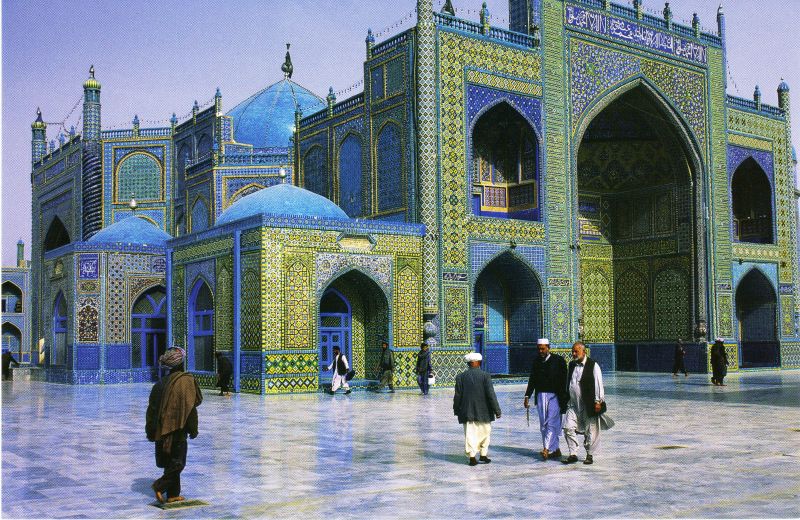
Shrine of Imam Ali A.S in Mazar-e-Shariff


According to Afghan-Network website, the tomb was covered with earth to escape the ravage of Genghis Khan in 1220 and remained lost until it was uncovered during the rebuilding work in 1480s. ap
Mazar-e Sharif (lit. Tomb of the Exalted) in northern Afghanistan is considered by Afghan Shi'a to be the final resting place of fourth caliph 'Ali bin Abi Talib (d. 661 A.H.). Legend contends that the caliph's body was moved from Najaf to a secret tomb near Balkh, which was "re-discovered" by a mullah in the village of Khwaja Khayran in early twelfth century. Seljuk sultan Sanjar erected a shrine on this site in 1136, which was probably destroyed in Mongol invasion of 1220. Timurid sultan Husain Baiqara (1469-1506) built the present shrine in 1480-81 (885 A.H.), furthering to the town's development into a large urban center. The shrine was restored extensively in the mid-twentieth century and draws Shi'a pilgrims throughout the year, and especially during the celebration of New Year (Neuroz).
The shrine is roughly rectangular in plan, and measures about fifty-three meters by thirty-eight meters at the largest. It is aligned northwest-southeast and is enclosed within a fenced precinct that includes the large mosque built in mid-twentieth century to the southwest of the shrine. A site plan of the shrine complex sketched by Niedermayer in 1916-1917 shows a smaller walled precinct, with bazaar streets leading out from the shrine to the southeast and, possibly, to the northwest. These historic structures were razed to create parklands later in the twentieth century, leaving only their monumental portals that now serve as gateways for the shrine. The taller northwest gateway faces the shrine with a grand pishtaq flanked by bi-level loggias and tall engaged minarets. It is included inside the paved grounds whereas the southeast gateway – a similar structure with a shallow arch and shorter minarets on the shrine side – is incorporated into the precinct fence and serves as the main entrance. (Its tiled street façade was built after the destruction of the adjoining bazaar.) The northeast gateway, which is seen as a gateway in Niedermayer's photographs, has a simpler structure composed of a screen wall pierced by twin archways.

The Timurid core of the shrine contains the tomb chamber of Ali and its ziaratkhana, whose blue-tiled domes rise above the shrine's roofline. A grand pishtaq flanked by bi-level loggias leads into the ziaratkhana, an ante-chamber dedicated to prayer and worship, from the southeast. Inside, the chamber has a cruciform plan extended with polygonal bays to the northeast and southwest. It is covered with a central dome about ten meters in diameter and opens into the caliph's room to its northwest. The larger tomb chamber is also cruciform in plan and is crowned by a taller dome of about fifteen meters in diameter. A doorway is centered at the end of each cross arm: the northeast door leads into an octagonal chamber that projects beyond the shrine's wall, while the northwest door opens onto a triple-domed portico, now enclosed with wooden screens. The southwest doorway, now a view-window with a metal grill, belongs to the monumental side portal.

Tombs of various shape and size belonging to Afghan rulers and religious leaders were added to the Timurid shrine through the centuries, creating its current irregular profile. The square domed tomb of Amir Dost Muhammad (1826-1863) and his family adjoins the southeast portal to its southwest. A similar tomb containing the graves of Amir Sher Ali (1863-1879) is located between this tomb and the side portal on the southwest façade.

The shrine's exterior is covered entirely with polychrome tile mosaic and painted tile panels dominated by shades of blue. Many of these tiles were renewed or replaced during twentieth century renovations. A continuous parapet and decorative turrets unify the jagged cornice line. Timurid interiors of the shrine have retained their original squinch-net vaulting; their epigraphic decoration, on the other hand, is mostly from the nineteenth century. The interior of the ziaratkhana dome, which is adorned with concentric rows of muqarnas on a sixteen-sided base, features painted arabesque decoration that may be of the Timurid period. The shrine has a rich treasury that contains, among other objects, a marble slab remaining from the Seljuk shrine inscribed with the words "Ali, Lion of God."

[36] As you approach the end of the road, note the Ministry of Agriculture on your left. The blue-domed Ziarat-i-Sakhi on the hillside straight ahead will also attract your attention. This is an extremely important shrine in Kabul, especially for the Shia community, for the Holy Cloak of the Prophet rested in a natural basin on top of a large stone now enshrined here. The Cloak had been obtained in 1768 from the Amir of Bokhara by Ahmad Shah Durrani (r. 1747-1772) as part of a treaty settling the northern boundaries. It is now enshrined in Qandahar, Ahmad Shah's capital, but while it was kept in Kabul for a few days during the journey, it is said that Hazrat Ali, cousin and son-in-law of the Prophet Mohammad, came to pay his respects to the holy relic. For this reason, the shrine is sometimes referred to as Qadamgah Hazrat-i-Shah or the Place Where Hazrat Ali Placed His Foot, i.e., visited. Sakhi (Generous One) is another title of Hazrat Ali. Because of these associations with Hazrat Ali the whole university area is generally referred to as Aliabad.

Tuesday, November 11, 2008

Official: Iraq, China finalize oil service deal to develop southern Iraqi field

By SAMEER N. YACOUB , Associated Press

Last update: November 11, 2008 - 9:00 AM


BAGHDAD, - Iraq and China have signed the final agreement on a $3 billion deal to develop the Ahdab oil field south of Baghdad over a 22 year-period, an Oil Ministry official said Tuesday.

An initial agreement was signed in Beijing last August, restoring a Saddam Hussein-era deal that was canceled after the 2003 U.S.-led invasion of Iraq.

The agreement was finalized on Monday at a ceremony in Baghdad, the official said on condition of anonymity because he was not authorized to speak to media.

Reporters were not invited to the ceremony for security reasons, he added.

The new agreement is the first Saddam-era oil deal to be honored by the new Iraqi government.

The deal provides for a service contract, under which China will not be a partner in profits and instead will be paid for its work in the Ahdab field. The oil field is located in Wasit province about 100 miles southeast of Baghdad.

It has been the scene of sporadic attacks since the U.S.-led invasion in 2003.

The official said as a start the field will produce 25,000 barrels a day with a target of 125,000 barrels.

Part of the oil produced in Ahdab will be used to generate electricity from a power station to be built in Wasit province, the official said.

Iraq sits on more than 115 billion barrels of oil, but decades of wars, U.N. sanctions, violence and sabotage have battered its oil industry.

As security improves, Iraq is trying to bring in foreign companies to help increase crude output from the current 2.5 million barrels a day to 3 million barrels a day by the end of 2008, and 4.5 million barrels a day by the end of 2013.

Wednesday, November 05, 2008

Obama asks Rep. Emanuel to lead White House staff

Obama names Panetta, Blair to top spy posts


09 Jan 2009 18:00:59 GMT
Source: Reuters
By Randall Mikkelsen

WASHINGTON, Jan 9 (Reuters) - President-elect Barack Obama named two intelligence outsiders on Friday to head the top U.S. spy agencies and play a leading role in restoring what he has called a tarnished U.S. image abroad.

Obama nominated Leon Panetta, White House chief of staff to former Democratic President Bill Clinton, as CIA director, and retired Adm. Dennis Blair to oversee all U.S. spy agencies as director of national intelligence.

Panetta and Blair did not come up through the ranks of intelligence agencies. Their nominations, which must be confirmed by the Senate, reflect Obama's determination to restore a U.S. reputation battered by accusations of torturing suspected terrorists and secret wiretapping of Americans' overseas phone calls.

"To be truly secure we must adhere to our values as vigilantly as we protect our safety, with no exceptions," Obama said in announcing his picks.

"Under my administration the United States does not torture. We will abide by the Geneva Conventions. We will uphold our highest ideals," he said.

He pledged to ensure that U.S. intelligence is accurate and untainted by politics, after intelligence failures before the Sept. 11 attacks and the Iraq war.

Obama rounded out the team with current or former intelligence professionals. He saluted the rank-and-file of the spy agencies, and stressed a need to defend the country against terrorism and other threats.

"There is no margin for error," he said.

Blair, 61, a U.S. Naval Academy graduate who earned a master's degree from Oxford while on a Rhodes scholarship, has served as commander of U.S. military forces in the Pacific, as well as stints on the White House National Security Council and as a CIA military liaison.

Panetta, 70, a former U.S. congressman, was White House budget director under Clinton before becoming his chief of staff, where he had access to presidential intelligence briefings.

CRITICISM, BUT NOT THREAT

The selections of Panetta and Blair have faced criticism, but there has been little sign yet that either would face a serious threat to his nomination.

Senate Intelligence Committee Chairwoman Diane Feinstein of California, whose panel will consider the choices, said this week the CIA would be better led by an intelligence professional.

After lobbying by Obama, Feinstein said she would listen to Panetta's plans. She said separately she intended to quickly confirm Blair.

Some human rights advocates say Blair was too close to Indonesia's military during his years as Pacific commander, when the country was accused of violating human rights in East Timor. A government watchdog, the Project on Government Oversight, has accused him of financial conflicts of interest.

Obama named a 25-year CIA veteran, John Brennan, as his White House counterterrorism and homeland security adviser.

He said the current national intelligence director, Michael McConnell, would serve on his Foreign Intelligence Advisory Board. He also would keep in place National Counterterrorism Center head Michael Leiter, whose agency oversees strategic planning of counterterrorism operations.

By putting Brennan in the White House in a job not needing Senate confirmation, Obama will have at his side a veteran spy who earlier withdrew from consideration to be CIA director amid public criticism that he was too closely tied to CIA policies on prisoner treatment. He denied the accusations.

Brennan was interim director of the counterterrorism center, formed after the Sept. 11 attacks. He founded an intelligence consulting firm in 2005.

(Editing by Eric Beech)

----


05 Nov 2008 21:20:23 GMT
Source: Reuters
(Recasts with Obama offering job to Emanuel)

By Caren Bohan

CHICAGO, Nov 5 (Reuters) - U.S. President-elect Barack Obama has asked Illinois congressman Rahm Emanuel to head his White House staff as he moves quickly to fill government jobs in his incoming administration.

Sources said that the chief of staff job was offered to Emanuel, 48, a senior Democratic lawmaker known for a hard-charging style, just hours after Obama was elected on Tuesday.

Emanuel, who has close ties to Obama's inner circle and is a fellow Chicagoan, was expected to accept the offer, which would make him the main gatekeeper to the Oval Office.

Obama could announce that decision and possibly other key posts, such as Treasury secretary, on Thursday. He has already launched a transition team and aides were "working fast to fill Obama's economic and homeland security teams," according to one of the Democratic sources.

Obama has little time to relax after he triumphed over Republican John McCain and made history as the first African American elected U.S. president.

He has just 11 weeks to prepare to grapple with two wars and a deepening financial crisis.

Former government officials and public policy experts say such early preparations are both prudent and necessary given the challenges the United States faces amid the Iraq and Afghanistan wars and economic turmoil.

"The need for a seamless transition is greater than it has been in our adult political lifetime," said William Galston, a former domestic policy adviser to President Bill Clinton who is now a professor at the University of Maryland.

"With two wars abroad and an international financial crisis going on, there cannot be a period in which the new administration is just getting up to speed," Galston added.

Speculation is already rife about several names for Treasury secretary, one of the hottest seats in Washington.

Whoever gets that job will be faced both with guiding the $700 billion economic bailout package and the regulatory reform needed to prevent a repeat of the current crisis.

The short list includes former Treasury Secretary Lawrence Summers, former Federal Reserve Chairman Paul Volcker and Timothy Geithner, president of the Federal Reserve Bank of New York.

New Jersey Democratic Gov. Jon Corzine, whose name has also been floated for the Treasury post, told CNBC on Wednesday he had not discussed joining the Obama administration with anybody, though he added he would never rule anything out.

Obama could soon announce other economic posts as well. Likely to end up in top advisory roles are University of Chicago economist Austan Goolsbee and Jason Furman, a former economic adviser to President Clinton.

FOREIGN POLICY ADVISERS

For secretary of state, Massachusetts Democratic Sen. John Kerry, former diplomat Richard Holbrooke, outgoing Republican Sen. Chuck Hagel and former Georgia Democratic Sen. Sam Nunn are among the names in the mix.

James Steinberg, a former Clinton adviser, is a top contender for national security adviser. Susan Rice, another former Clinton aide, could be considered for that job or another senior post.

Obama also relies heavily on three foreign policy experts on his campaign staff who are likely to end up in the White House or State Department. Those three aides are Mark Lippert and Denis McDonough, both former Senate aides, and Ben Rhodes, Obama's foreign policy speechwriter.

With wars under way in Iraq and Afghanistan, Obama might consider keeping Robert Gates on as secretary of Defense. He might also consider tapping former Navy Secretary Richard Danzig, a close adviser.

Obama's campaign is maintaining the utmost secrecy on planning for the transition, which will occur in the 11 weeks between Nov. 4 and Jan. 20, when he will be sworn in as successor to President George W. Bush.

Obama has said he had "some pretty good ideas" about people he might tap for senior jobs and that he would "absolutely" include Republicans in his Cabinet. (Additional reporting by Thomas Ferraro, Richard Cowan and Donna Smith in Washington and Deborah Charles in Chicago; Editing by Eric Beech)

-------------
President-elect Obama has appointed a 150% Zionist, Rahm Manuel, as his chief of staff. Mr Emanuel is the son of an Israeli who served as member of the Irgun terrorist gang that killed 50 British officers at King David Hotel in Jerusalem. In 1991, Emanuel left America to join the Israeli army. In all his actions, Emanuel put Israeli interests first. While a political and policy aide to President Clinton he helped to appoint Clinton Jewish cabinet: Albright, Cohen, Rubins, Berger, Reich, Cohen and spokesman Reubens. He is also credited with the nomination of Jewish Monika Lewinsky as a Whitehouse internist.

For this reason, the Arab Israeli conflict was put on the back burner While Clinton and Albright were busy tightening the economic sanctions on Iraq and savagely bombarding Baghdad in 1998. According to Albright, Clinton was unable to force the Israelis to implement one single UN resolution out of 39 they are in breach off because of Monika affair.

So here we go again in 2008. Another Clinton-style Jewish cabinet will be formed with the aim of serving Israeli interest first. During the 2000 elections the Arabs voted against Gore for having Jewish Lieberman as his running mate and supported George Bush. What a disappointment; as G.W. permitted the Zio-cons to infest the Whitehouse, to give unlimited support for Israel and to declare war on Islam.

Enlightened Arabs and Muslims are not fooled by Obama and know the extent of the Jewish stranglehold on American politics. So it is back to square one. Obama will continue renedering strong US financial, military and political support for Israeli atrocities; which were cited by Bin Laden as the reason for the 9/11attacks on the Jewish mafia HQ at WTC that financed Israel and on the Pentagon that arms it.
While Al-Qaeda wanted McCain to win the 2008 presidential election in order to continue G.W. Bush bankrupt policies, nevertheless, it seems that President- elect Obama will not deprive them of pretexts to continue attacking USraeli targets.

-----------

FACTBOX - Possible cabinet choices for Obama
07 Nov 2008 23:25:54 GMT
Source: Reuters
Nov 7 (Reuters) - U.S. President-elect Barack Obama is expected to move quickly to announce members of his Cabinet to start tackling the economic crisis as well as other pressing issues including the wars in Iraq and Afghanistan.

Obama has announced that Illinois congressman and fellow Chicagoan Rahm Emanuel will head his White House staff, and said at his first news conference on Friday that he expects to make other announcements within weeks.

Here are some of the possible choices for key Cabinet positions.

SECRETARY OF DEFENSE

- Defense Secretary Robert Gates was sworn in by outgoing President George W. Bush on Dec. 18, 2006. Obama voted to confirm him. Gates served as CIA director from 1991 until 1993.

- Richard Danzig is a close adviser to Obama. He served as Navy secretary under President Bill Clinton. He also served as Navy undersecretary from 1993 to 1997.

TREASURY SECRETARY

- Lawrence Summers served as Treasury secretary under Clinton. The former president of Harvard University has been a top adviser to Obama.

- Timothy Geithner is president of the New York Federal Reserve Bank. He served as Treasury undersecretary for international affairs during the Clinton administration.

SECRETARY OF STATE

- Sen. John Kerry of Massachusetts was the Democratic candidate in the 2004 presidential election. A Vietnam War veteran, he was first elected to the U.S. Senate in 1984.

- Sam Nunn is a former senator from Georgia who chaired the Senate Armed Services Committee. Nunn has long been viewed as a leading Democratic voice on foreign policy.

- Sen. Chuck Hagel of Nebraska, an outspoken member of the Committee on Foreign Relations, has been a leading Republican critic of the Bush administration's Iraq invasion. He is retiring from the Senate, having served two terms.

DIRECTOR OF THE OFFICE OF MANAGEMENT AND BUDGET

- Peter Orszag has headed the nonpartisan Congressional Budget Office since January 2007. He previously served as an economic adviser to President Clinton.

U.S. TRADE REPRESENTATIVE

- Dan Tarullo is a professor at Georgetown University law school. He is a specialist on trade and international economics. As a senior White House aide to Clinton, he helped prepare for meetings of the Group of Seven industrialized economies.

ATTORNEY GENERAL

- Eric Holder served as deputy Attorney General under Clinton. He has been a senior legal advisor to Obama's campaign and helped vet Obama's vice presidential candidates.

- Arizona Gov. Janet Napolitano, first elected in 2002 and re-elected in 2006, is a former U.S. Attorney. She has been called a pro-business centrist Democrat.

AGRICULTURE SECRETARY

- Tom Vilsack is a former governor of Iowa, an agriculture state carried by Obama. In 2006 he became the first Democrat to announce his candidacy for president. He quickly withdrew and later endorsed Sen. Hillary Clinton. Vilsack is an attorney who specializes in energy conservation, renewable energy and agribusiness development.

- Kansas Gov. Kathleen Sebelius, re-elected to a second term in 2006, had been considered a potential running mate for Obama.

- Charles Stenholm, a former Democratic congressman from Texas, was a cotton producer before running for Congress. He followed agricultural issues closely until he lost his seat in the 2004 election. (Compiled by Donna Smith; Editing by Xavier Briand)


==============
Rahm's gone: New day, new tone for the White House

By BEN FELLER, AP White House Correspondent Ben Feller, Ap White House Correspondent – 16 mins ago

WASHINGTON – Reshaping the tone and tenor of the White House, President Barack Obama on Friday replaced the colorful and caustic Rahm Emanuel with the private Pete Rouse as his chief of staff, shifting to a new phase of his presidency with a drastically different aide as trusted gatekeeper.

Emanuel's decision to quit the White House and run for Chicago mayor had been so well known that even Obama mocked the lack of suspense. But it still felt like the most important transition to date for the Obama operation, which has been fueled for nearly two years by Emanuel's demands, drive and discipline.

At an emotional farewell, Obama said, "We are all very excited for Rahm, but we're also losing an incomparable leader of our staff." Emanuel choked up as he said his goodbye.

Into the breech steps Rouse, an Obama senior adviser known around the White House as a problem-fixing, media-shy strategist and organizer. Rouse is expected to serve as interim chief for several months and may eventually get the permanent job, as the White House is in the midst of reviewing a broader shake-up.

Considered the most consuming and influential staff job in American politics, the chief of staff shapes nearly everything at the White House — how the president spends his time, how he pursues his strategies on foreign and domestic policy, how he deals with a politically deadlocked Congress and a skeptical electorate.

Distinctive, profane and combative in his approach, Emanuel was a bruising but successful manager often known simply as "Rahm." The jarring contrast between the outgoing and incoming chiefs of staff was on full display as Obama spoke of both men in the grand East Room, which was packed with staff members.

Emanuel waved to colleagues, whispered to his children in the first row and stood familiarly with his hands on hips, as if ready to get going. Rouse was quiet and stoic except for the occasional smile. He almost seemed to shy away into the background even as Obama lauded his skills and his results.

"It's fair to say that we could not have accomplished what we've accomplished without Rahm's leadership," Obama said. The president singled out Emanuel's work on signature health care and financial reform legislation, hugged him more than once and told his audience: "I will miss him dearly."

Emanuel choked up when his turn came. He spoke of his family's immigrant background, the opportunities he's been afforded, his pride in Obama.

=============


Michael Moore advices to Barak Obama!


Subject: 5 Things Dems Can Do to Turn It Around by November 2nd

1. Immediate Wall-to-Wall TV Ads, Internet Videos, and Appearances Hammering Who the Hell Put Us in the Misery We're In.
We Americans have very short attention spans (Quick: Who Won the Oscar for Best Picture last year? The World Series? Exactly.). People need to be reminded over and over that it was the REPUBLICANS who concocted and led the unnecessary invasion of two countries, putting us in our longest war ever, wars that will eventually cost us over $3 trillion. Bush and Co. also caused the biggest collapse of our economy since the Great Depression. I don't know a single person in Hollywood who wouldn't shoot and produce those spots for you for FREE. Dems: Do not pull a single punch on this. Quit being a bunch of wusses and let the bastards have it! The public will be astonished that you've found your courage and your spine. We expect you to be Muhammad Ali, not Ally McBeal.
wuss (wʊs)
n. Slang
A person regarded as weak or timid and especially as unmanly: "Cats are for wusses, dog men say" (Laura Blumenfeld).


2. Indict the Criminals.
Announce that the Justice Department will seek indictments against both those who caused the economic collapse and those who became war profiteers. Call it for what it is: organized crime. Use the RICO statutes. Use the basic laws that make fraud of any kind a crime. Get in the face of those who stole the billions, make them pay for it -- and the people will love you. We want Dirty Harry, not Dirty Dancing.

3. Announce a Moratorium on All Family Home Foreclosures.
Last month (August) there were more home foreclosures than in any month in U.S. history. Worse than any month in the worst year ever, 2009. The bleeding hasn't stopped -- it's only gotten worse. And now, this week, two of the largest crime organizations who are throwing hundreds of thousands of people out of their homes (GMAC and JPMorgan Chase) have been forced to momentarily stop doing this. It turns out, they don't really have the paperwork to prove they actually own these houses! It's madness. So if you do one thing for the middle class this week, do this. It will take an hour of your time to draw up the decree and issue it. We'd rather watch "It's a Wonderful Life" than "Poltergeist." (A ghost that manifests itself by noises, rappings, and the creation of disorder.)

4. Announce a New 21st Century WPA.
"Who's hiring? THE GOVERNMENT IS HIRING!" Put together a simple plan to hire enough people to repair our roads, fix up our aging schools, and rebuild our infrastructure. Fund this by taxing the richest 1% who have more financial wealth than 95% of Americans combined! Unemployment will drop to 5%. Can you pass it? Well, you sure can't unless you try! And as you're trying, announce that you will force the Republican senators (who until now simply have had to say they "intended" to filibuster in order to kill a bill) to have to actually filibuster! Make them stand on the floor of the Senate and read from the phone book 24/7. They won't last a day. And America will see them for who they really are. (The use of obstructionist tactics, especially prolonged speechmaking, for the purpose of delaying legislative action.
An instance of the use of this delaying tactic.
An adventurer who engages in a private military action in a foreign country.)

5. Declare That No Democrat Will Accept ANY Wall Street Money in the Next Election Cycle.
Pick a day in the coming week. Have all your fellow Democrats in Congress stand in front of the Capitol (with President Obama) and pledge that if America allows you to retain control of Congress, none of you will take a penny from Wall Street for the 2012 election. Instead, promise to accept donations of only $2, $5 and $10. You will also pledge not to take a job as a lobbyist or lawyer for ANY corporation for ten years after you leave Congress. The message will be a powerful one to the average American fed up with corrupt political hacks. Act like Honest Abe, not Fast Freddie -- and see what happens.

And here are two bonus suggestions: Use what sense of humor you have and go after these candidates and their agenda with all the hilarious ridicule they deserve. And quit complaining about "the base" not doing enough to help you. You want help? Do something this week to earn it. I've offered five suggestions. I'm sure the rest of "the base" has a few more.

Yours,
Michael Moore
MMFlint@aol.com
MichaelMoore.com

Commnts: Excellent advice. I like his indirect attacks on the Jewish financial mafia and on the war profiteers. But can a hapless and weak president challenge the Jewish mafia controlling Washington D.C.
Adnan Darwash, Iraq Occupation Times

Tuesday, November 04, 2008

Obama , Ahmadinejad and Imam Mehdi AJTFJ

Assalamou 'alaikoum wa Rahmatou Allahi wa Barakatouhou;

Letter from Barack Obama on His Muslim Heritage

Je m'excuse auprès du MODERATEUR, mais je n'ai pas eu le temps de traduire, d'autant plus que de l'anglais, au Français, GOOGLE (options linguitiques" fait un bon travail)...

There has been a lot made in the recent weeks about the Muslim history of my family. Some of the things that have been said are true, others are false, so I am writing this letter to clear up the misunderstandings on this issue.

Yes, it is true that I have a name that is common amongst Kenyan Muslims where my father came from and that my middle name is Hussein. Barack is a name which means "blessing" and Hussein is a masculine form of the word beauty. Since there is nothing inherently wrong with the concept of blessings from God and the beauty He creates I fail to see the problem with these names. Some will say wouldn't it be a problem to have a president with a name similar to the deposed and executed former dictator of Iraq? My answer to this is simply no; rather it is the strength
and beauty of America that the son of an African man with a "funny sounding" name, born under British Colonial Rule, can now be a serious candidate for the presidency of the United States .

My father was a Muslim and although I did not know him well the religion of my father and his family was always something I had an interest in. This interest became more intense when my mother married an Indonesian Muslim man and as a small child I lived in Indonesia and attended school alongside Muslim pupils. I saw their parents dutifully observing the daily prayers, the mothers covered in the Muslim hijab, the atmosphere of the school change during Ramadan, and the festiveness of the Eid celebrations.
The man my mother was married to was not particularly religious; but he would attend the mosque on occasion, and had copies of the Quran in different languages in the home, and books of the sayings and life of the Prophet Muhammad. From time to time he would quote Islamic phrases such as "no one truly believes until he wants for his brother what he wants for himself", "oppression is worse than slaughter", and "all humans are equal the only difference comes from our deeds".

Growing up in Hawaii with my mother and her grandparents Islam largely escaped my mind. My mother installed in me the values of humanism and I did not grow-up in a home were religion was taught.

It was later while I attended college at Columbia University and Harvard Law that I became reacquainted with Muslims as both schools had large Muslims student populations. Some of them were my friends and many came from countries that our nation now has hostile relations with. The background I had from my early childhood in Indonesia helped me get to know them and learn from them and to me Muslims are not to be looked upon as something strange. In my experiences up until college a Muslim was no less exotic to me than a Mormon, a Jew, or a Jehovah's Witness.

After college I settled in my adopted hometown of Chicago and lived on the South Side and worked as a community organizer. Chicago has one of the largest Muslim populations in America (estimated to be around 300,000) and Muslims make-up some of the most productive citizens in the area. I met countless numbers of Muslims in my job as an organizer and later on in my early political career. I ate in their homes, played with their kids, and looked at them as friends and peers and sought their advice.

Therefore, when the tragic terrorist attacks of 9-11 occurred I was deeply saddened with the rest of America , and I wanted justice for the victims of this horrific attack, but I did not blame all Muslims or the religion of Islam. From my experience I knew the good character of most Muslims and the value that they bring to America. Many, who did not personally know Muslims, indicted the entire religion for the bad actions of a few; my experience taught me that this was something foolish and unwise.

Later I had the chance to visit the homeland of my father and meet Muslim relatives of my including my grandmother. I found that these were people who wanted the same things out of life as people right here in America and worked hard, strive to make a better way for their children, and prayed to God to grant them success.

This is what I will bring to the office of the Presidency of the United States. I will deal with Muslims from a position of familiarity and respect and at this time in the history of our nation that is something sorely needed .

--------------
Commentary: Obama and Ahmadinejad
Amir Taheri 10.26.08, 1:33 PM ET

Is Barack Obama the “promised warrior” coming to help the Hidden Imam of Shi’ite Muslims conquer the world?

The question has made the rounds in Iran since last month, when a pro-government Web site published a Hadith (or tradition) from a Shi’ite text of the 17th century. The tradition comes from Bihar al-Anwar (meaning Oceans of Light) by Mullah Majlesi, a magnum opus in 132 volumes and the basis of modern Shi’ite Islam.

According to the tradition, Imam Ali ibn Abi-Talib (the prophet’s cousin and son-in-law) prophesied that at the End of Times and just before the return of the Mahdi, the Ultimate Saviour, a “tall black man will assume the reins of government in the West.” Commanding “the strongest army on earth,” the new ruler in the West will carry “a clear sign” from the third imam, whose name was Husayn ibn Ali.

The tradition concludes: “Shi’ites should have no doubt that he is with us.”

In a curious coincidence Obama’s first and second names – Barack Hussein – mean “the blessing of Husayn” in Arabic and Persian.

His family name, Obama, written in the Persian alphabet, reads O Ba Ma, which means “he is with us,” the magic formula in Majlesi’s tradition.

Mystical reasons aside, the Khomeinist establishment sees Obama’s rise as another sign of the West’s decline and the triumph of Islam.

Obama’s promise to seek unconditional talks with the Islamic Republic is cited as a sign that the U.S. is ready to admit defeat. Obama’s position could mean abandoning three resolutions passed by the United Nations Security Council setting conditions that Iran should meet to avoid sanctions.

Seeking unconditional talks with the Khomeinists also means an admission of moral equivalence between the U.S. and the Islamic Republic. It would imply an end to the description by the U.S. of the regime as a “systematic violator of human rights.”

Obama has abandoned claims by all U.S. administrations in the past 30 years that Iran is “a state sponsor of terrorism.” Instead, he uses the term “violent groups” to describe Iran-financed outfits such as Hamas and Hezbollah.

Obama has also promised to attend a summit of the Organization of the Islamic Conference within the first 100 days of his presidency.

Such a move would please the mullahs, who have always demanded that Islam be treated differently, and that Muslim nations act as a bloc in dealings with Infidel nations.

Obama’s election would boost President Mahmoud Ahmadinejad’s chances of winning a second term next June. Ahmadinejad’s entourage claim that his “steadfastness in resisting the American Great Satan” was a factor in helping Obama defeat “hardliners” such as Hillary Clinton and, later, it hopes, John McCain.

“President Ahmadinejad has taught Americans a lesson,” says Hasan Abbasi, a “strategic adviser” to the Iranian president.

“This is why they are now choosing someone who understands Iran’s power.” The Iranian leader’s entourage also point out that Obama copied his campaign slogan “Yes, We Can” from Ahmadinejad’s “We Can,” used four years ago.

A number of Khomeinist officials have indicated their preference for Obama over McCain, who is regarded as an “enemy of Islam.” A Foreign Ministry spokesman says Iran does not wish to dictate the choice of the Americans but finds Obama “a better choice for everyone.” Ali Larijani, Speaker of the Islamic Majles, Iran’s ersatz parliament, has gone further by saying the Islamic Republic “prefers to see Barack Obama in the White House” next year.

Tehran’s penchant for Obama, reflected in the official media, increased when the Illinois senator chose Joseph Biden as his vice-presidential running mate. Biden was an early supporter of the Khomeinist revolution in 1978-1979 and, for the past 30 years, has been a consistent advocate of recognizing the Islamic Republic as a regional power.

He has close ties with Khomeinist lobbyists in the U.S. and has always voted against sanctions on Iran.

Ahmadinejad has described the U.S. as a “sunset” (ofouli) power as opposed to Islam, which he says is a “sunrise” (tolou’i) power.

Last summer, he inaugurated an international conference called World Without America--attended by anti-Americans from all over the world, including the U.S.

Seen from Tehran, Obama’s election would demoralize the U.S. armed forces by casting doubt on their victories in Iraq and Afghanistan, if not actually transforming them into defeat.

American retreat from the Middle East under Obama would enable the Islamic Republic to pursue hegemony of the region.

Tehran is especially interested in dominating Iraq, thus consolidating a new position that extends its power to the Mediterranean through Syria and Lebanon.

During the “World Without America” conference, several speakers speculated that Obama would show “understanding of Muslim grievances” with regard to Palestine.

Ahmadinejad hopes to persuade a future President Obama to adopt the “Iranian solution for Palestine,” which aims at creating a single state in which Jews would quickly become a minority.

Judging by anecdotal evidence and the buzz among Iranian bloggers, while the ruling Khomeinists favour Obama, the mass of Iranians regard (and dislike) the Democrat candidate as an appeaser of the mullahs. Iran, along with Israel, is the only country in the Middle East where the United States remains popular. An Obama presidency, perceived as friendly to the oppressive regime in Tehran, may change that.

--

Amir Taheri is the author of 10 books on Iran, the Middle East and Islam. His new book “The Persian Night: Iran Under the Khomeinist Revolution” will be published by Encounter Books in November.

----
www.biography.com/featured-biography/barack-obama/index.jsp
Barack Obama, the junior U. S. Senator from Illinois, is the first ever African–American to become the presumptive presidential nominee for a U. S. major political party. On June 3, 2008, he gained enough delegates to be nominated by the Democratic party at its national convention in August.

Barack Hussein Obama was born Aug. 4, 1961, in Honolulu, Hawaii. His father, Barack Obama, Sr., was born of Luo ethnicity in Nyanza Province, Kenya. He grew up herding goats with his own father, who was a domestic servant to the British. Although reared among Muslims, Obama, Sr., became an atheist at some point.

Obama’s mother, Ann Dunham, grew up in Wichita, Kansas. Her father worked on oil rigs during the Depression. After the Japanese attack on Pearl Harbor, he signed up for service in World War II and marched across Europe in Patton’s army. Dunham’s mother went to work on a bomber assembly line. After the war, they studied on the G. I. Bill, bought a house through the Federal Housing Program, and moved to Hawaii.

Meantime, Barack’s father had won a scholarship that allowed him to leave Kenya pursue his dreams in Hawaii. At the time of his birth, Obama’s parents were students at the East–West Center of the University of Hawaii at Manoa.

Obama’s parents separated when he was two years old and later divorced. Obama’s father went to Harvard to pursue Ph. D. studies and then returned to Kenya.

His mother married Lolo Soetoro, another East–West Center student from Indonesia. In 1967, the family moved to Jakarta, where Obama’s half-sister Maya Soetoro–Ng was born. Obama attended schools in Jakarta, where classes were taught in the Indonesian language.

Four years later when Barack (commonly known throughout his early years as "Barry") was ten, he returned to Hawaii to live with his maternal grandparents, Madelyn and Stanley Dunham, and later his mother (who died of ovarian cancer in 1995).

He was enrolled in the fifth grade at the esteemed Punahou Academy, graduating with honors in 1979. He was only one of three black students at the school. This is where Obama first became conscious of racism and what it meant to be an African–American.

In his memoir, Obama described how he struggled to reconcile social perceptions of his multiracial heritage. He saw his biological father (who died in a 1982 car accident) only once (in 1971) after his parents divorced. And he admitted using alcohol, marijuana and cocaine during his teenage years.

After high school, Obama studied at Occidental College in Los Angeles for two years. He then transferred to Columbia University in New York, graduating in 1983 with a degree in political science.

After working at Business International Corporation (a company that provided international business information to corporate clients) and NYPIRG, Obama moved to Chicago in 1985. There, he worked as a community organizer with low-income residents in Chicago’s Roseland community and the Altgeld Gardens public housing development on the city’s South Side.

www.monstersandcritics.com/dvd/reviews/article_1423765.ph...

en.wikipedia.org/wiki/Barack_Obama

www.barackobama.com/about/

www.barackobama.com/splash/first_to_know.html

-------------
By Bill Rigby - Analysis

NEW YORK (Reuters) - U.S. defense contractors thrive as well during Democratic administrations, if not better, than in Republican ones, and the likely election of Barack Obama as president offers no hint of being an exception.

Defense is still largely a labor intensive, old-line manufacturing business, with close ties to the Democratic Party, and no president wants to do anything that would cut American jobs, especially in a time of economic distress.

"This president is going to care more about manufacturing jobs than any other president in a generation," said Loren Thompson, an analyst at the Lexington Institute, an Arlington, Virginia-based think-tank which specializes in defense issues.

"People will be surprised at how stable weapons spending will be. Is Barack Obama really going to cut military purchases at major weapons plants in swing states like Florida, Virginia and Colorado?"

Besides economic concerns, the United States still faces security threats and the growth of China's ambitions, making cuts to big defense programs even more unpopular.

"The basic, core defense budget will not be reduced because I don't think it can afford to be reduced," said Clay Jones, chief executive of Rockwell Collins Inc (COL.N: Quote, Profile, Research, Stock Buzz), which makes cockpit gear for military and commercial planes.

"If you believe what (the candidates) have said, I don't think they are going to come in and gut the defense budget."

END OF THE PARTY

Growth in military spending is expected to moderate after the war-fueled bonanza under President George W. Bush, but no one in the industry expects spending to go down.

U.S. defense spending climbed over 60 percent during the Bush administration, to $542.5 billion for fiscal 2009, plus $70 billion of supplemental funding for Iraq and Afghanistan.

The supplemental budget would be the first to go, if Obama moved to draw down the U.S. military presence in Iraq. That would hurt companies that supply hardware and logistics to active U.S. forces, but could free up money for long-term contracts building fighters, bombers, warships and missiles -- the bread and butter for Lockheed Martin Corp (LMT.N: Quote, Profile, Research, Stock Buzz), Northrop Grumman Corp (NOC.N: Quote, Profile, Research, Stock Buzz) and other big contractors.

At worst, the growth in core defense spending "will slow to the rate of inflation, about 2 or 3 percent," said Jones at Rockwell Collins, from the 5 to 8 percent annual growth under Bush.

Despite that relatively strong outlook in the face of a recession, defense companies have been punished alongside other sectors in the recent market-wide selloff. Further dips would be a good time to buy, some analysts say.

The Standard & Poor's Aerospace and Defense index , which had fallen 35 percent this year at Monday's close, was up more than 4 percent on Tuesday as Obama took a handy opinion poll lead into election day.

DEMOCRATS LIKE WEAPONS TOO

History suggests no basis for investor pessimism.

"Defense stock performance and budget growth have shown little correlation with the party in the White House or the party in control of Congress," said Sanford C. Bernstein analyst Douglas Harned, in a research note this week.

If anything, Democrats are the big spenders.

"If you look at the full sweep of the 20th century, Democrats presided over four of the five big weapons build-ups," said Lexington's Thompson, referring to two World Wars, Korea and Vietnam.

The exception is the Cold War build-up under Ronald Reagan during the 1980s. His successor, Bill Clinton, established the modern-day preconception that Democrats cut defense budgets by slashing spending in the 1990s as the United States reacted to the Soviet Union's demise.

MCCAIN FEAR

Defense contractors would probably dislike a surprise victory by Republican candidate John McCain, whose crusade against Boeing Co's (BA.N: Quote, Profile, Research, Stock Buzz) sway over the U.S. Air Force helped establish his reputation as a maverick in Washington, D.C.

"There's a peculiar mismatch between people's stereotypes of the parties and the way they actually behave in regard to the defense industry," said Thompson. "Senior Republicans like (Dick) Cheney, (Donald) Rumsfeld and McCain detest the defense industry. Senior Democrats actively court it."

Former Secretary of Defense Rumsfeld never spoke directly to leaders of defense contractors about his ambitious plans to modernize U.S. weaponry. Many top executives at defense contractors are lifelong Democrats, according to Thompson.

"McCain would be much worse for defense contractors," he said. "They might make as much as money, but be miserable doing it. McCain starts with the assumption that the defense industry is corrupt."

WINNERS AND LOSERS

Likely losers in the event of an Obama win are companies with lucrative contracts supplying U.S. forces in Iraq, such as bullet-maker Alliant Techsystems Inc (ATK.N: Quote, Profile, Research, Stock Buzz), armor plate maker Ceradyne Inc (CRDN.O: Quote, Profile, Research, Stock Buzz), or large contractors making fighting vehicles such as General Dynamics Corp (GD.N: Quote, Profile, Research, Stock Buzz) and BAE Systems Plc (BAES.L: Quote, Profile, Research, Stock Buzz).

Boeing looks like a winner, given Democrats' staunch support for the company in its effort to win a controversial $35 billion refueling tanker contract, which will be put up for grabs again next year.

Lockheed's massive Joint Strike Fighter project also looks to be safe, as a prime example of a major jobs-providing program, which it would be political suicide to cut.

(Reporting by Bill Rigby, editing by Gerald E. McCormick)

============

Cessation of Iraq hostilities hits BAE Systems

By Rebecca Burn-Callander Thursday, 16 February 2012
Peace is bad for business at BAE. The defence giant today reported a nosedive (A very steep dive of an aircraft.)in annual revenues following cuts in the UK and America.
Tagged by:

Economy,
Government,
Saudi Arabia,
Enterprise,
Defence,
BAE Systems,
US,
UK,
BAE,
Aerospace & Defence

Further Reading

European manufacturing contraction slows
Britain's Most Admired Companies 2011: Engineering - aero & defence sector
Government announces enterprise zones in BAE redundancy hotspots
BAE defenceless over job cuts

The end of the Iraq war, Obama’s US defence cuts and slashed UK military spending have caused a spot of turbulence for BAE, manufacturer of everything from rifle bullets to the Typhoon jet fighter. Turnover has lost altitude: £19.2bn in sales for 2011, down 14% on the previous year. And profits have plunged by 7% to an EBITDA of £2bn.

The ‘age of austerity’ has been troublesome for the London-headquartered firm. It generates 47% of its revenues from the US and 29% from Britain. The former has just capped its defence budgets while the UK has sliced 8% off its miltary spending over the next four years. Competition for remaining defence contracts is fierce: just this month, BAE lost out to French rival Dassault on a $11bn (£7bn) contract to make an Indian government fighter jet.

Chief executive Ian King says: ‘BAE Systems is operating in a difficult business environment as defence spending reduces in its largest markets, the US and UK. Whilst little sales growth can be expected for the group in 2012 in the current market conditions, modest growth in underlying earnings per share is anticipated.’

BAE does have a few other lucrative contracts pending, however: an order for 72 Eurofighter Typhoon jets by Saudi Arabia is still in the pipeline, albeit delayed. And BAE’s R&D tax settlement for 2011 is due to land any minute.

Like many other major defence players, BAE is trying to get into new markets - particularly the fragmented and rapidly growing pirvate security business. But in the meantime, its fortunes are tied to western government budgets, so it's in for a pretty thin time...

============

Sunday, November 02, 2008

Letter of Imam Mehdi AJTFJ

این نامه از ناحیه مقدس حضرت صاحب الزمان ( ارواحنا فداه) در اوخر ماه صفر المظفر سال 410 به سوی شیخ مفید ارسال شده است
نامه ای به برادر با ایمان و دوست رشید ( نیرومند) ما، ابوعبدالله محمد بن محمد بن نعمان- شیخ مفید- که خداوند عزت وی را مستدام بدارد
سلام خداوند بر تو ای کسی که در دوستی ما به زیور اخلاص آراسته ای و در اعتقاد و ایمان به ما دارای امتیاز مخصوص هستی. ما در مورد نعمت وجود تو خداوند بزرگ را سپاسگزاریم و از پیشگاه مقدس خداوند استدعا می کنیم که بر سید و مولای ما حضرت محمد بن عبدالله ( صلی الله علیه و آله) و خاندان او درود و صلوات پیاپی و بینهایت خویش را نازل فرماید
از آنجا که در راه یاری حق و بیان سخنان و نصایح م صادقانه کوشیدی، خداوند این افتخار را به شما ارزانی داشته و به ما اجازه داده است تا با شما مکاتبه کنیم. شما مکلف هستید که اوامر و دستورات ما را به دوستان ما برسانی، خداوند عزت و توفیق اطاعتش را به آنان مرحمت فرماید و مهمات آنان را کفایت کرده، در پناه لطف خویش محفوظشان دارد
با یاری خداوند متعال در مقابل دشمنان ما که از دین خداوند روی برگردانده اند بر اساس تذکرات، استقامت کن و با خواست الهی دستورات ما را به آنان که از تو می پذیرند و گفتار ما موجب آرامش آنان می باشد ابلاغ کن . با اینکه ما بر اساس فرمان خداوند بزرگ و صلاح واقعی ما و شیعیانمان تا زمانی که حکومت در دنیا در اختیار سمتگران است در نقطه ای دور و پنهان از دیده ها به سر می بریم، ولی از تمام حوادث و ماجراهایی که بر شما می گذرد کاملا مطلع هستیم و هیچ چیز از اخبار شما بر ما پوشیده نیست. از خطاها و گناهانی که بندگان صالح خداوند از آنها دوری می کردند ولی اکثر شما مرتکب آن شدید نیز باخبریم
از عهد شکنی ها و پشت سر گذاشتن عهد و پیمان ها با اطلاعیم. گویی اینها از لغزشهای خود خبر ندارند، با همه این گناهان، ما هرگز امور شما را مهمل نگذاشته، شما را فراموش نمی کنیم و اگر عنایات و توهات ما نبود، مصائب و حوادث، شما را در بر می گرفت و دشمنان شما را از بین می بردند. پس از خداوند بترسید تقوی پیشه کنید و به ما خاندان رسالت مدد رسانید.
در برابر فتنها یی که پیش می آید، و البته عده ای در این آزمایش و برخورد با فتنه ها هلاک می شوند مقاومت کنید و البته همه این ها ا ز نشانه های حرکت و قیام ما هستند. اوامر و نواهی ما را متروک نگذارید و بدانید که علیرغم کراهت و ناخشنودی کفار و مشرکان، خداوند نور خود را تمام خواهد کرد. تقیه را از دست ندهید و از آتشی که جاهلیت به رهبری بنی امیه افروخته است بپرهیزید. من که ولی خدا هستم سعادت پویندگان راه حق را تضمین می کنم
در این سال در ماه جمادی الاولی حوادثی به وجود می آید که باید از آن عبرت بگیرید. در آسمان علامت و نشانه ای ظاهر می شود که کاملا روشن است و نیز نشانه ای در زمین همانند و مساوی آن پیدا خواهد شد. در مشرق زمین حادثه ای به وجود می آید که موجب حزن و اندوه و اضطراب است. پس از آن گروهی از امت اسلامی که در واقع با اسلام بیگانه هستند بر عراق مستولی خواهند شد و در نتیجه اعمال بد آنها وضع زندگی و ارزاق مردم سخت می شود. آنگاه با هلاک شدن طاغوت آن زمان، بندگان با تقوا خوشحال می شوند و راه حق خانه خدا بر اهلش گشوده می شود و به آسانی حج می کنند و امر مردم طبق مراد و خواسته آنها منظم خواهد شد
پس سعی کنید اعمال شما طوری باشد که شما را به ما نزدیک سازد و از گناهانی که موجبات نارضایتی ما را فراهم نماید بترسید و دوری کنید.
امر قیام ما با اجازه خداوند به طور ناگهانی انجام خواهد شد و دیگر در آن هنگام توبه فایده ای ندارد و سودی نمی بخشد. عدم التزام به دستورات ما موجب می شود که بدون توبه از دنیا بروند و دیگر ندامت و پشیمانی نفعی نخواهد داشت
ای شیخ مفید! خداوند شما را با الهامات غیبی خود ارشاد و توفیقات خویش را در سایه رحمت بی پایانش نصیب شما فرماید

ازدواح والدين مقدس اردبيلي


شخصي کنار جوي آبي نشسته بود ، ديد سيبي بر روي آب مي آيد دست برد و سيب را برداشت و خورد . بعد از خوردن سيب به فکر افتاد که اين سيبي که خوردم از کجا بود ؟ از کدام باغ بود ؟ رفت تا به باغي که سيب از آن باغ بود ، رسيد . وقتي صاحب باغ را پيدا کرد از او سئوال کرد : من سيبي از روي آب برداشتم و خوردم و بعد فهميدم که سيب از باغ شما بوده است . نزد شما آمده ام که مرا حلال کنيد يا آنکه قيمتش را بپردازم . صاحب باغ در جواب گفت : اين باغ فقط از من نيست ، ما چهار برادريم و من سهم خودم را به شما بخشيدم . گفت : بسيار خوب ، آن سه برادر کجا هستند ، جواب داد : دو تا ديگر از برادرانم در ايران هستند و يکي در خارج از ايران


نزد آن دو برادر رفت و حلاليت طلبيد و سپس بار سفر بست و به خارج از ايران رفت ( گويا برادر ديگر در شوروي بوده است ) و خود را به در خانه ي آن برادر رسانيد و قصه را بيان کرد . آن برادر چهارم تعجب کرد که اين فرد کيست که براي يک چهارم سيب اين همه راه را طي کرده و به اينجا آمده تا حلاليت بطلبد . گفت : من سهم خودم را به شما بخشيدم ولي به يک شرط . و آن شرط اين است : دختري دارم از چشم ، کور و از زبان ، لال و از گوش ، کر است اگر قبول کني با او ازدواج کني حلالت مي کنم و الا نه

جوان قدري تامل کرد و پذيرفت

وقتي مراسم عقد تمام شد و داخل حجله رفتند ، عروس را حوريه اي از حوران بهشتي ديد . از حجله بيرون آمد و به پدر دختر گفت : شما گفتيد دخترتان کور و کر و لال است . گفت : آري ، من دروغ نگفتم ، گفتم : کور است چون تا به حال چشمش به نامحرم نيفتاده ، و اينکه گفتم : کر است ، گوش او صداي نامحرم و صداي ساز و آواز و غنا نشنيده ، و گفتم : لال است ، زبانش به دروغ و غيبت و ناسزا و تکلم با نامحرم باز نشده است . مدتها از درگاه حضرت حق درخواست مي کردم که خدايا داماد خوبي که هم کفو اين دختر باشد به من مرحمت کن . خدا دعاي مرا مستجاب کرد و دامادي متقي چون تو که اين همه مسافت راه را پيمودي ، براي اين که يک چهارم سيبي را که خوردي حلال باشد نصيبم کرد .

از اين ازدواج خداوند فرزندي صالح و بي نظير ، عالمي رباني افقه الفقهاء زمان شيخ احمد مقدس اردبيلي را عنايت فرمود